21 hours ago
Sunday, April 27, 2014
Jack Crepes
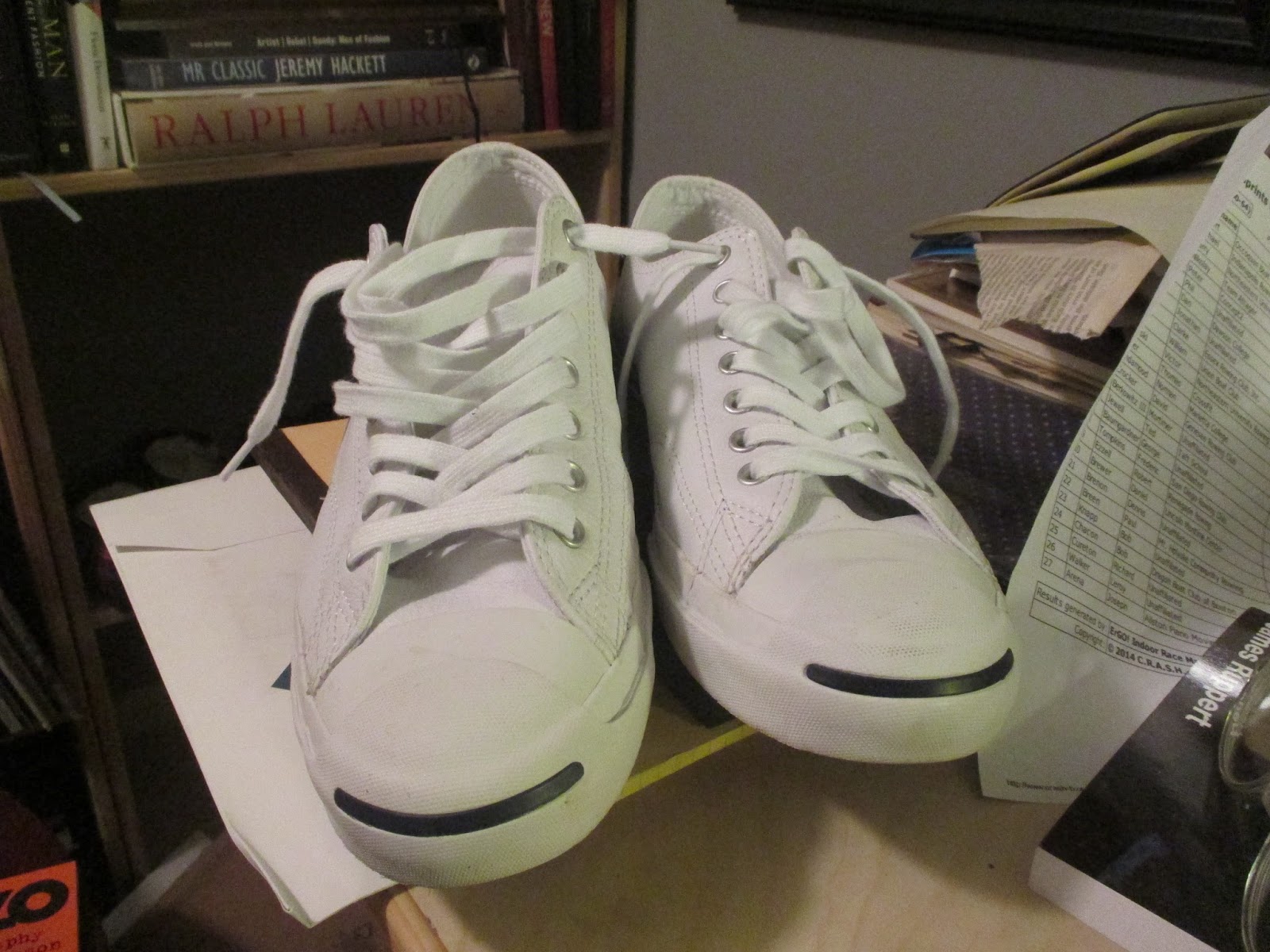
I worry that I'm becoming a hoarder. If I like something I buy several, just in case I'm never able to find another. Lately, I've been stocking up on Jack Purcell badminton shoes. Canvas, leather, blue, white, dirty white all reside in my closet, my collection felt compete until I came across the Crepe Collection from Converse, for spring/summer 2014.
Imagine crepe soled Jacks! Brothel creepers for the masses. From what I can tell they do not go one sale until mayday, but I'll be first in line when they do. Shuttlecocks anyone?
Toad
Labels:
4/27,
crepe collection,
jack Purcells
Friday, April 25, 2014
Snowy Mountain
Snowy Mountain by Cui Ruzhuo
Real life is so much better than make believe. The painting above, Snowy Mountain by Chinese artist Cui Ruzhuo, sold at auction for US $3.7 million in Hong Kong earlier this week, has gone missing.
Security film shows a guard kicking the painting into a pile of trash; later janitors tossed the trash and likely Snowy Mountain as well. Interested parties are combing the local landfills, I suspect that it was stolen, but that appears to be a minority opinion. Should you happen to find it, Poly Auction in Hong Kong would love to hear from you.
Toad
Labels:
4/25,
cui ruzhuo,
poly auctions,
snowy mountain
Wednesday, April 23, 2014
Follow up day
I'm having a difficult time moving out of vacation mode. I'm tired, sore and unmotivated, for that I blame Fitbit's weekly stat report. Below is yesterday's report summary:
Hi Toad D., here are your weekly stats.
4/14/2014 to 4/20/2014
Wed, Apr 16 WEEK'S MOST ACTIVE DAY
Thu, Apr 17 WEEK'S LEAST ACTIVE DAY***
88,855 TOTAL STEPS (2100 steps/mile)
12,694 steps DAILY AVERAGE
BEST DAY 17,767 steps
213,549 total lifetime steps
TOTAL DISTANCE
42.07 miles
6.01 miles DAILY AVERAGE
BEST DAY 8.41 miles
*** Thursdays and Sundays are rest days.
I was hesitant to buy a pedometer figuring that once I knew how far I walked I'd lose interest in tomorrow. So far Fitbit has kept the dogs and I moving, but we are too tired to care any more. Perhaps we need to join someone's friend group.
II. Two Books
I have recently come across 2 books you may be interested in. The first for the Brits and car guys is "The British Car Industry Our Part in its Downfall" by James Ruppert retells the story of the mass suicide of British car manufacturing in the 1960's and 70's, as seen from the cars in the Ruppert family's garage. If you have owned and loved Brit cars for as long as I have you know some of the story, but there were still bits I was unaware of,such as how the British Army re-created Volkswagen after the war, and how while BMW owned Rover, BMW co-opted the ready to market Mini and developed their X line of 4 wheel drive cars using Land Rover technology.
The other of more general interest is "The Ayatollah Begs to Differ" by Hooman Majd.
Mr. Majd, the son of a Iranian diplomat during the Shah's reign was educated in Britain and the US, now lives in America, and is a frequent visitor to Iran where members of his family still live. Iran is still too misunderstood in the west and Mr. Majd attempts to lift the veil and give westerners a look at how the people, government and the Shia branch of Islam coexist. He provides a clever look at and context for modern Iran.
III. Tom: the Unknown Tennessee Williams
I picked this up at Faulkner House book story in Nola and am finding it a slog. Have you gotten through it? Is it worth the continued effort?
Toad
Hi Toad D., here are your weekly stats.
4/14/2014 to 4/20/2014
Wed, Apr 16 WEEK'S MOST ACTIVE DAY
Thu, Apr 17 WEEK'S LEAST ACTIVE DAY***
88,855 TOTAL STEPS (2100 steps/mile)
12,694 steps DAILY AVERAGE
BEST DAY 17,767 steps
213,549 total lifetime steps
TOTAL DISTANCE
42.07 miles
6.01 miles DAILY AVERAGE
BEST DAY 8.41 miles
*** Thursdays and Sundays are rest days.
I was hesitant to buy a pedometer figuring that once I knew how far I walked I'd lose interest in tomorrow. So far Fitbit has kept the dogs and I moving, but we are too tired to care any more. Perhaps we need to join someone's friend group.
II. Two Books
I have recently come across 2 books you may be interested in. The first for the Brits and car guys is "The British Car Industry Our Part in its Downfall" by James Ruppert retells the story of the mass suicide of British car manufacturing in the 1960's and 70's, as seen from the cars in the Ruppert family's garage. If you have owned and loved Brit cars for as long as I have you know some of the story, but there were still bits I was unaware of,such as how the British Army re-created Volkswagen after the war, and how while BMW owned Rover, BMW co-opted the ready to market Mini and developed their X line of 4 wheel drive cars using Land Rover technology.
The other of more general interest is "The Ayatollah Begs to Differ" by Hooman Majd.
Mr. Majd, the son of a Iranian diplomat during the Shah's reign was educated in Britain and the US, now lives in America, and is a frequent visitor to Iran where members of his family still live. Iran is still too misunderstood in the west and Mr. Majd attempts to lift the veil and give westerners a look at how the people, government and the Shia branch of Islam coexist. He provides a clever look at and context for modern Iran.
III. Tom: the Unknown Tennessee Williams
I picked this up at Faulkner House book story in Nola and am finding it a slog. Have you gotten through it? Is it worth the continued effort?
Toad
Monday, April 21, 2014
Seersucker at Stein Mart
To my mind, a late Easter calls for men to wear seersucker, and for the first time in a decade, I awoke Sunday morning without benefit of a traditional blue/white seersucker suit. Bubba, the iconic white, horizontally striped number slept soundly in the closet awaiting its season. I am simply without.
My plan was to visit Perlis while in NOLA, but rains, volume unseen since Noah, kept me closer to downtown. Instead, I visited Rubensteins. If you haven't been there I suggest a walk through. Rubensteins provides a level of service unheard of in your community. I am convinced, a gentlemen of means, could soundly rely upon Rubensteins staff to regularly refresh his wardrobe, sight unseen. Once they get the cut of your jib, there will be no need to call ahead with your wants, somehow they'll know what and when and have it ready to ship.
I'm between sizes, and likely to be for a while, that's why I'm hesitant to replace my missing suit. I did look though, and have this suggestion for you guys unfamiliar with seersucker, or uncertain if you can pull it off. Seersucker looks good on anyone confident to wear it.
Stealing from one of ADG's post last fall, I went to Stein Mart to see Flusser's summer offerings. I am reluctant to pay a lot for a suit that won't get much wear. That puts my favorite seersucker, BB's, out of reach, for now. Stein Mart is offering good looking Flusser seersucker seperates, $60 for the jacket, $30 for pants. Tell 'em ADG sent ya.
Toad
Labels:
4/21,
ADG,
seersucker
Friday, April 18, 2014
The White Shoe Rule 2014
Several years ago I reached out to Mr. David Bagwell, esteemed Fairhope, Alabama attorney and overall nice guy in an effort to persuade him to allow me to reprint his story The White Shoe Rule. David graciously consented and I have been thankful ever since. David's "Rule" is required reading no matter on which side you dress, just in time for Easter Week.
David Bagwell, by the way, lives in Point Clear, Alabama and has his own "White Shoe Law Firm" in Fairhope, Alabama, both on Mobile Bay.
THE WHITE SHOE RULE AND STRAW HAT DAY
By
David A. Bagwell
Fifty years ago, and more, the tradition in the Deep South was that beginning on Easter weekend -- well before what people now call “Memorial Day”-- it became safe to wear white pants and skirts, white shoes and spectators, and a straw hat. I lump all that light-colored stuff together into what I call “The White Shoe Rule”.
Some Southerners today don’t buy that. They say that The White Shoe Rule doesn’t start until what we now call “Memorial Day”. Most of those people seem unusually certain that they know what they are talking about. But Southern tradition suggests that they are wrong.
It’s a serious fashion question, even in this time of war and economic travail. Maybe it’s idle and frivolous to speak of the rules of fashion anytime, some think, but even during war and elections and recession, life moves on, and so must we.
So, when may we properly begin --and when must we properly stop-- the wearing of white? Good question.
Do you remember the book The Southern Belle Primer by the wonderful [late] Marilyn Schwartz, whose subtitle was to the effect that Her Royal Highness Princess Margaret could never get into Kappa Kappa Gamma sorority because she wore white shoes in Texas the wrong time of year? I’m convinced that a lot of people beyond princesses misunderstand all this “White Shoe Rule” stuff. A lot of us don’t know as much about our dress code history as we should, or as much as we think for that matter.
Oh, sure; I know that every written source on fashion which might mention it, will say that you cannot wear white or straw hats before “Memorial Day”; we’ll get to all that in a moment. What you will read in those books is just – out with it now – just the Yankee rules. It’s ok for them to have their rules, but here in the South, ours were always different.
Of course nobody should wear white all of the time. In 1880 Mark Twain wrote of his character Colonel Grangerford that “every day of his life he put on a clean shirt and a full suit from head to toe made out of linen so white it hurt your eyes to look at it.” But every day? Even in winter? In deepest winter, now, you’ll obviously make a spectacle of yourself in white. Mark Twain did. On December 7, 1906, when Mark Twain went to a copyright law hearing in the Capitol in Washington, D.C.– in December in Washington, mind you – he wore a suit of white wool flannels, not white linen. But the ruckus he raised by wearing a white suit in Washington in the winter landed him in stories in the New York Times, Herald, and Tribune the next morning. Of course, his point about copyrights was in the article, too, which just goes to show you that clothing can not only make a fashion statement, it can also help your substantive statement get published. Twain said funereally that “when a man reaches the advanced age of 71 years as I have, the continual sight of dark clothing is likely to have a depressing effect upon him”. And “a group of men in evening clothes looks like a flock of crows, and is just about as inspiring”, he said. But, if you aren’t 71 and you aren’t Mark Twain, and it is not 1906–and I’m not and it isn’t– you must pay some attention to these rules, you know. Which means that you must know what the rules are.
The first thing to understand is that there are EXCEPTIONS to all this White Shoe Rule stuff, no matter when the starting date is.
One exception is "The Southern Resort Exception". At any Southern resort, like Boca Grande or Palm Beach or farther off in Bermudan or Carribean resorts and all that, white clothes and straw hats are ALWAYS allowed, regardless of the season. My father told me that the Northerners who went to the University of Alabama with him in the early 1930s wore white shoes all winter, on the apparent theory that Tuscaloosa was a Southern resort, which is clearly twelve points off true north.
What’s a “Southern resort”, anyway, outside of Boca Grande or something? Well, the place where I live – Point Clear on Mobile Bay -- qualifies as “a Southern resort”, although locals don’t wear white shoes here in the winter. What about Charleston and Savannah and Mobile? Well, maybe, but that’s pushing it. My correspondent in Charleston reports that a man dressed in all white, especially if any of it is patent leather, tends to be called there “full Cleveland”. To an Englishman, any place where it is warm, and not raining at that moment, is apparently considered a “Southern resort”, which is precisely how H.R.H. Princess Margaret got in such hot water out in Texas for wearing white shoes in Dallas before their time– whatever their time is in Dallas. There are wonderful photos of Winston Churchill in a white suit, often wearing his favorite white panama Stetson in the “Open Road” pattern; you know, the pattern which in gray was worn by LBJ and by every single graduate of the Colorado School of Mines. But whites in London? A British judge told me once that, years before, he looked out his office window one summer day and saw his boss wearing a white suit and white panama hat in London, and that he involuntarily exclaimed at the sight “A Panamanian ponce!” [“ponce” of course being English slang for procurers for pay of the favours of exceptionally fast females].
The second exception to the White Shoe Rule is “The Yacht Exception”. I am not sure of the breadth of this exception, either, never having owned a yacht and all, but I think that weather permitting, you may always wear white clothes on a yacht, at least if you don’t change your own engine oil, and no gentleman does that. This may be a sub-theorem of the Southern Resort Rule, since one always keeps her yacht in the South during the winter, doesn't she? And, speaking of The Late Princess Margaret, since the British Royal family has sent the Royal Yacht BRITANNIA to the wreckers for scrap, I just don’t know where they wear their whites, other than maybe Dallas in a pinch. The picture on my wall of Commodore Vanderbilt on his yacht – and before “The Late Unpleasantness” his yacht was the biggest yacht in the world – shows him in black wool with fur trim, so obviously it is not de rigeur that you wear whites on your yacht in winter. What’s a yacht? Well, paraphrase what J.P. Morgan said about “if you have to ask . . .” I do know that none of my little canoes and ducking skiffs and kayaks and rowboats and motor skiffs is “a “yacht”, and so mostly I just wear khaki shorts.
OK, exceptions aside, what exactly is The Rule?
Well, everybody agrees on the ENDING date of The White Shoe Rule, namely, that after Labor Day, you cannot wear white pants or suit or shoes, unless you meet one of the exceptions. It's just the BEGINNING date for The White Shoe Rule that causes the problem.
To Northerners, the rule was always-- at least after Memorial Day was declared, after the Civil War -- that you cannot wear white pants or skirts or suits or shoes until what Northerners have mostly called “Memorial Day” [earlier perhaps “Decoration Day”], which is now of course the last Monday in May.
But then that’s Northerners. Both my ancient memory and my research confirm that in general, over the South, Easter weekend – and not Memorial Day-- was the beginning for the White Shoe Rule. Remember that Easter was the day on which boys got a new white linen coat, if their parents could afford one? And white shoes? They didn’t wait until “Memorial Day”.
That Easter rather than Memorial Day was the starting date for The White Shoe Rule in the Deep South is not surprising, for two reasons. First, the South obviously gets hot earlier than the North does; I mean, what level are we on? Second, what we now call “Memorial Day” was originally set up as a memorial for Union soldiers in the Civil War, and when and where I grew up in Alabama, it was called “Yankee Memorial Day”. Here in Alabama the Federal workers got a holiday on “Yankee Memorial Day”, but the State workers got the holiday on “Confederate Memorial Day”, which in Alabama was April 26th [The rest of us in the private world, fusionists like L.Q.C. Lamar in John F. Kennedy’s book Profiles in Courage, always worked on both Yankee Memorial Day and Confederate Memorial Day]. Nobody in the deep South would have dated a fashion requirement or anything else from Yankee Memorial Day. Easter was it.
My theory is that the people who think that the first day of The White Shoe Rule is Yankee Memorial Day rather than Easter, and who are moving the fashion goal posts from Easter to Yankee Memorial Day, are just one small part of the general Yankee-fication of America. National Public Radio, no less, reported that Texas singer “Kinky” Friedman, late of the singing group “Kinky Friedman and the Texas Jewboys”-- Kinky won the “Male Chauvinist of the Year” Award of The National Organization for Women with his song “Put Your Biscuits in the Oven and Get Your Buns Back in Bed”-- ran for governor of Texas in 2006 on the platform “Stop the Wuss-ification of Texas”. Kinky lost, but that is just a small skirmish in the larger battle.
But, for some reason– I don’t know why-- Easter was not necessarily the beginning day for straw hats for men. Strangely and “counter-intuitively”, as intellectuals seem to say, there was often a totally separate and clear rule for straw hats, and it certainly wasn’t Yankee Memorial Day, which was far too late to switch to straw hats in the Deep South or anywhere. There was something called “Straw Hat Day” in the old days when people wore hats, and on “Straw Hat Day” it was like some Fred Astaire musical with a chorus, and everybody in unison– men and women, but mostly men -- all doffed their felt hats and put on their straw hats.
When was “Straw Hat Day”? Well, if you research it on the internet you’ll find all kinds of things. “Straw Hat Day” in Pennsylvania was when Penn played baseball against Princeton on the second Saturday in May; some people say in Philadelphia Straw Hat Day was on that second Saturday, and some say on May 15th. Surprising numbers of people dogmatically declare that May 15th was and is and is to be “National Straw Hat Day”, as if President Coolidge or somebody had so decreed. Well, not so fast. There wasn’t ever a “National Straw Hat Day”, and there isn’t now; there was always a whole lot of local option in the deal and in the deep South it tended to be earlier. We had a “Straw Hat Day” in the cities in Alabama where I grew up, and surely in many other towns, but it was not May 15th; instead, it was both a moveable feast and a changing target. The Mobile Register on April 10, 1912 ran this story suggesting that in the late 19th century “Straw Hat Day” was April Ninth:
A number of the old veterans of the Veteran Volunteer Firemen’s Association enjoyed a banquet given at Dauphin and Jackson streets last night. Formerly the ninth of April was a day of great festivities in Mobile. The firemen pulled out their engines and paraded with them amid the acclamations of the entire populace of Mobile and music furnished by bands.
The day was the day recognized as the beginning of spring and straw hats and spring frocks made their appearance and general celebration was indulged in. This custom was in vogue up to the year 1888.
[We presume that the “veterans” part meant “veterans of The Late Unpleasantness”]. What do you suppose happened in 1888 to change this tradition? Well, in 1888 the first paid professional fire department was started in Mobile, which killed this celebration.
So what took its place after 1888 with respect to straw hats? Likely nothing in Mobile, between 1888 and 1931, other than fashion chaos. In 1915 in Jacksonville, Florida, the Mayor and Police Chief declared a “Straw Hat Day” and almost caused a revolution, and apparently they dropped it. In the twentieth century, after 1931 anyway,“Straw Hat Day” in Mobile was on whatever springtime day the Mayor’s proclamation of “Straw Hat Day” said it would be, but it was always just before Easter, usually on either Maunday [or “Holy”] Thursday, or the next day on Good Friday, just in time for the spring and Easter– read: white– finery to flower. The earliest recorded Mayor’s proclamation of Straw Hat Day in Mobile that I found in the City Archives was in 1931.
Why was it in 1931? Well, it’s hard to say for sure, but one clue is that the local paper, the Mobile Register for March 7, 1931, said "The first straw hat of 1931 appeared on Royal and Dauphin streets yesterday, far ahead of the official advent of spring. The latest model of 'head-gear' was worn by a stylishly dressed man, who did not seem embarrassed by eyes that stared and comments made as he passed along the avenues". Maybe the uncertainty of the proper beginning day for straw hats in March of 1931–sounds to me like the first day of Spring on March 20th or 21st tended to be the date to most people – prompted the male populace to demand that the Mayor set a clear official beginning date for straw hats; who knows at this point? While the files are not complete, these proclamations of “Straw Hat Day” seem to have run pretty steadily from 1931 until John Kennedy ran for president in 1960, when fashionable young men decided that fashionable young men simply did not wear hats any more. If fashionable young men don’t wear hats, then there is no need for a “Straw Hat Day”.
These old Mayoral proclamations here of “Straw Hat Day” are wonderful throwbacks to another world of springtimes filled with wisteria and azaleas, usually reciting in multiple “whereases” that “Mobile is a veritable flower garden with the air scented with street perfume and the streets lined with the riotous coloring of floral displays”, that “our birds are singing everywhere and their songs are the harbingers of new life and springtime”, noting the date of the Mobile Bears’ opening baseball game and pointedly proclaiming that the proper hat to be worn at all baseball games “is a STRAW hat” – note that it is not a baseball cap– and declaring “Straw Hat Week”. “All citizens of the city”-- and not just men-- were “urged to put away their winter chapeaux and to replace them with sparkling new STRAW HATS”. So Straw Hat Day was always just before Easter. “Straw Hat Day” in the South never had anything to do with Yankee Memorial Day.
I’m not the guy to talk about women’s Mardi Gras finery in Mobile and New Orleans, other than admiring it and paying for it, but everybody knows that women beat Easter to the punch by forty or more days during Mardi Gras, wearing light clothes and straw hats.
But, then in the fall, the Southern cities would flip back to felt hats, on some designated day after Labor Day which was proclaimed by the Mayor. Generally this was called “Felt Hat Day” and nationwide it tended to be on September 15th. In warm and humid Mobile it tended to be a little later, about the beginning of dove season. In Montgomery where I grew up, that day was called “Anti-Straw Hat Day” and back in the 1920s it was September 15, which we self-employed people now commemorate instead as a day to pay the Internal Revenue Serve its quarterly tax payment. In Montgomery on one such Anti-Straw Hat Day in the 1920s Montgomery Mayor Will Gunter issued this proclamation:
Whereas the weather has been dry and the pastures burned up and the supply of roughage for the cows, mules, and horses, as well as goats and sheep, has been exhausted, now therefore I, Mayor W.A. Gunter, Jr., do hereby proclaim that these animals will be authorized to attack anyone found wearing a straw hat on the streets today or hereafter and such citizens are at their own peril and must defend themselves without recourse to the police department or other guardians of the law. – W.A. Gunter, Jr., Mayor
[The Montgomery Advertiser reported that the next day the Mayor showed up at the office in his straw hat and told the reporters that “he was going to risk the cow’s designs upon his headgear until next pay-day came around, through force of necessity”.]
And, it’s worth noting in passing – since it is clearly forgotten by most of us– that back before air conditioning became general, there were official Mayoral proclamations banning suits and coats in the daytime in the summer, beginning about July 1st. Apparently in Mobile around which I live and work, the “Coats Off Campaign” in late summer was started by the Junior Chamber of Commerce just after WWII, and by the middle 1950s Southern mayors often proclaimed that beginning on “Sport Shirt Day” on July 1st or 2nd or something, and usually running all summer until the official first day of fall on September 21, “the proper, modest and polite attire for gentlemen in the City [shall] be and the same is hereby declared to be a neat, lightweight sports shirt instead of coat and necktie for all occasions from sunrise to sunset, and also proper evening attire except for formal occasions”. In Tuscaloosa, Alabama in the mid-1950s, the Mayor in the third week in April “proclaimed the opening of the sport shirt, straw hat and sport shoe season for the comfort of the city’s male population”, some three months before they did that here on the coast.
Now, why in the world was all of that ever abandoned in the South? Obviously the advent of air conditioning nipped it, but still, that is a tradition that Southerners ought to have preserved, just as they ought to have preserved more old buildings and houses and all of that. Here in Fairhope we still have a sportshirt tradition in both the summer and the winter, and we impart this tradition to our sons and grandsons in Homeric song before the fire of an evening. Now, admittedly, this fashion stuff was mostly higher- income people in the first place, and whether or not this date was observed by a man plowing a mule –switching his and his mule’s hats from the wool hat to the straw hat– I just cannot say for sure. But I can say for sure that a man who wore a felt hat until Yankee Memorial Day looked pretty strange indeed on a Southern street. So did a man who even recognized Yankee Memorial Day, for that matter.
But these rules seem to be moving fast. Friends – those who know – say that at the Fairgrounds in New Orleans, plenty of the horse owners in the winners’ circle wear white suits in the early spring, even shortly after Mardi Gras. Maybe New Orleans always started wearing white after Mardi Gras; I don’t know, or maybe even never stopped wearing white? Is New Orleans a “Southern resort”? But, why-oh-why do New Orleanians have to wear those black shoes and bright shirts and ties with their white suits; it’s Atticus Finch morphing into “Fast Eddie’s Used Cars”, for Heavens’ sakes.
The edges of The White Shoe Rule are increasingly ragged. In the women’s fashion field, there is some analog to “Moore’s Law” in computers, such that the rapidity of changes in fashion trends tends to multiply by a factor of four every three years, or something. Attractive young women in high fashion who are inexplicably close to me report that “modern fashionistas wear white year-round to get that ‘edgy look’ as they call it”, not following any rule but their own. Examples? Wearing white leather boots in the winter, for instance; obviously not meant for summer, but still white. The apparent idea of “edginess” is “intentional fashion faux pas”. But, the edgy look of white shoes year round can only be pulled off by those who are, you know – edgy. “On the average woman, it will simply look like someone who didn’t quite know whether it was Easter or Memorial Day yet.” Which is still better than those white patent shoes and belt on Fast Eddie’s used car lot, and all. Whether white rubber boots on a shrimper are “edgy” or not, I’ll let you decide; I mean, some of these questions are pretty far out.
Well, I don’t have a yacht, and I’m not too sure this is a southern resort, but for my money, white clothes are ok from Easter through Labor Day, on clear days anyway, and being reasonable about it, like “ok at garden parties but not funerals”. Suit yourself, but if you don’t agree, then you must be a Yankee. Which is ok. But let’s just recognize the possibility of diversity on this question.
Thank you David!
Toad
Thank you David!
Toad
Labels:
4/18. white shoe rule 2014
Thursday, April 17, 2014
Nubile
Nubile, once simply meant of marriageable age (street legal) now has such ugly connotations. At the cost of outing myself as a MCP, thinking back to beaches crowded with bored, bikini clad golf widows and pools filled with young Canadian school marms soothes the soul. Memories of beach front bars with sundressed patrons are helping to ease my transition to real life. I thank the gods that women dress to impress other women.
While unwilling to do the Google circle thing, I do want to give a WOW to the customer service department of J Crew. I screwed up big time, placing my annual Jack Purcell order and having it sent to our old address. By the time I realized my mistake, the package had shipped. I was anticipating a hassle, but a couple of emails later the Crew crew cancelled my original order, refunded the charges and reordered with the correct address. My package was waiting for me when I arrived home. Crew has a new friend.
Wouldn't you hate waking up knowing that today you were going to thread shoe strings in tennis shoes all day?
Toad
Labels:
4/17,
j crew,
managing ignatius,
nubile
Tuesday, April 15, 2014
Dial up Internet? Still?
Home again, home again, jiggity jog.
It's always good to go, but so much better to come home. Florida was lovely, with only 2 lousy weather days.
Biblical rain has followed us these past few weeks. We brought New Orleans torrential rains. I'd never been wetter. It stormed the week between trips in Mayberry as well, with weather warning blowing as we left on our drive down south. No point sticking around to watch bad weather.
My parents rarely travelled for recreation, but when they did my father was in full comand. The order of the day was to leave before sun up, drive several hours then stop for breakfast. After we ate, the only stops were for gas, until mid afternoon. Then we stop for the night at a highway motel, swim, eat and crash.
I inherited my father's predilection for leaving early, it likely made sense in pre-a/c equppied cars, but Mrs. T dsabused of that notion. Now, we leave whenever it's convenient, usually mid afternoon. Stopping as necessary so we hit Atlanta in time for rush hour and enjoy the ride. I like our way better.
We drove to Captiva, Florida which lies slightly west of Ft. Myers arriving just in time to pick up Mrs. T's 2 sons at the local airport. We did little while there other than eat (at home), lie in the sun and recover from a long winter. I won't bore you with "we had more fun than you" because we didn't. None the less it was a glorious and sorely needed vacation.
I'm glad to be home though. It's snowing as I write this, but surrounded by the dogs, my toys and the comforts of home I don't care. It's good to go, it's better to return. I think I'll curl up with the Odyssey.
PS: Driving 2500 miles dependant upon local radio stations made me recall the days when FM radio was a radical idea. Where else could you hear Janis Joplin or The Chambers Brothers on the radio. Like too much else the money boys FU'ed fm radio too, turning into the AM goo FM was meant to subvert. Having to endure 4+ days of mindless 3 minute pop, my head is about to explode. Next time I hear Happy someone may get hurt.
I am glad you're here. Many thanks
Toad
Labels:
4/15,
glad to be home
Wednesday, April 9, 2014
Mr. President
Mr. President:
It is with pain that I announce to Your Excellency the surrender of the Army of Northern Virginia.
The operations which preceded this result will be reported in full. I will therefore only now state that upon arriving at Amelia Court House on the morning of the 4th with the advance of the army, on the retreat from the lines in front of Richmond and Petersburg, and not finding the supplies ordered to be placed there, nearly twenty-four hours were lost in endeavoring to collect in the country subsistence for men and horses. This delay was fatal, and could not be retrieved.
The troops, wearied by continual fighting and marching for several days and nights, obtained neither rest nor refreshment; and on moving on the 5th, on the Richmond and Danville railroad, I found at Jetersville the enemy's cavalry, and learned of the approach of his infantry and the general advance of his army toward Burkeville.
This deprived us of the use of the railroad, and rendered it impracticable to procure from Danville the supplies ordered to meet us at points of our march. Nothing could be obtained from the adjacent country. Our route to the Roanoke was therefore changed, and the march directed upon Farmville, where supplies were ordered from Lynchburg.
The change of route threw the troops on the roads pursued by the artillery and wagon trains west of the railroad, which impeded our advance and embarrassed our movements. On the morning of the 6th General Longstreet's corps reached Rice's station on the Lynchburg railroad. It was followed by the commands of Generals R.H. Anderson, Ewell, and Gordon, with orders to close upon it as fast as the progress of the trains would permit or as they could be directed (diverted) on roads father west.
General Anderson, commanding Pickett's and B.R. Johnson's divisions, became disconnected with Mahone's division, forming the rear of Longstreet. The enemy's cavalry penetrated the line of march through the interval thus left, and attacked the wagon train moving toward Farmville. This caused serious delay in the march of the center and rear of the column, and enabled the enemy to mass upon their flank. After successive attacks Anderson's and Ewell's corps were captured or driven from their position. The latter General, with both of his division commanders, Kershaw and Custis Lee, and his brigadiers, were taken prisoners.
Gordon, who all the morning, aided by General W.F. Lee's cavalry, had checked the advance of the enemy on the road from Amelia Springs and protected the trains, became exposed to his combined assaults, which he bravely resisted and twice repulsed; but the cavalry having been withdrawn to another part of the line of march, and the enemy, massing heavily on his (Gordon's) front and both flanks, renewed the attack about 6 P.M., and drove him from the field in much confusion.
The army continued its march during the night, and every effort was made to reorganize the divisions which had been shattered by the day's operations. But the men being depressed by fatigue and hunger, many threw away their arms, while others followed the wagon trains and embarrassed their progress.
On the morning of the 7th rations were issued to the troops as they passed Farmville, but the safety of the trains requiring their removal upon the approach of the enemy all could not be supplied. The army, reduced to two corps under Longstreet and Gordon, moved steadily on the road to Appomattox Court House. Thence its march was ordered by Campbell Court House, through Pittsylvania, toward Danville. The roads were wretched and the progress of the trains slow.
By great efforts the head of the column reached Appomattox Court House on the evening of the 8th, and the troops were halted for rest. The march was ordered to be resumed at 1 A.M. on the 9th. Fitz Lee, with the cavalry, supported by Gordon, was ordered to drive the enemy from his front, wheel to the left, and cover the passage of the trains, while Longstreet, who from Rice's Station had formed the rear-guard, should close up and hold the position. Two battalions of artillery and the ammunition wagons were directed to accompany the army, the rest of the artillery and wagons to move toward Lynchburg.
In the early part of the night the enemy attacked Walker's artillery train near Appomattox Station on the Lynchburg railroad, and were repelled. Shortly afterward their cavalry dashed toward the Court House, till halted by our line.
During the night there were indications of a large force massing on our left and front. Fitz Lee was directed to ascertain its strength, and to suspend his advance till daylight if necessary. About 5 A.M., on the 9th, with Gordon on his left, he moved forward and opened the way. A heavy force of the enemy was discovered opposite Gordon's right, which, moving in the direction of Appomattox Court House, drove back the left of the cavalry and threatened to cut off Gordon from Longstreet. His cavalry at the same time threatening to envelop his left flank, Gordon withdrew across the Appomattox River, and the cavalry advanced on the Lynchburg road and became separated from the army.
Learning the condition of affairs on the lines, where I had gone under the expectation of meeting General Grant to learn definitely the terms he proposed in a communication received from him on the 8th, in the event of the surrender of the army, I requested a suspension of hostilities until these terms could be arranged. In the interview which occurred with General Grant in compliance with my request, terms having been agreed on, I surrendered that portion of the Army of Northern Virginia which was on the field, with its arms, artillery, and wagon-trains, the officers and men to be paroled, retaining their side-arms and private effects. I deemed this course the best under all the circumstances by which we were surrounded.
On the morning of the 9th, according to the reports of the ordnance officers, there were 7892 organized infantry with arms, with an average of 75 rounds ammunition per man; the artillery, though reduced to 63 pieces with 93 rounds of ammunition, was sufficient. These comprised all the supplies of ordnance that could be relied on in the State of Virginia. I have no accurate report of the cavalry, but believe it did not exceed 2100 effective men. The enemy was more than five times our numbers. If we could have forced our way one day longer it would have been at a great sacrifice of life, and at its end I did not see how a surrender could have been avoided. We had no subsistence for man or horse, and it could not be gathered in the country. The supplies ordered to Pamplin's Station from Lynchburg could not reach us, and the men, deprived of food and sleep for many days, were worn out and exhausted.
With Great Respect
Your Obedient Servant
R.E. Lee
Genl.
It is with pain that I announce to Your Excellency the surrender of the Army of Northern Virginia.
The operations which preceded this result will be reported in full. I will therefore only now state that upon arriving at Amelia Court House on the morning of the 4th with the advance of the army, on the retreat from the lines in front of Richmond and Petersburg, and not finding the supplies ordered to be placed there, nearly twenty-four hours were lost in endeavoring to collect in the country subsistence for men and horses. This delay was fatal, and could not be retrieved.
The troops, wearied by continual fighting and marching for several days and nights, obtained neither rest nor refreshment; and on moving on the 5th, on the Richmond and Danville railroad, I found at Jetersville the enemy's cavalry, and learned of the approach of his infantry and the general advance of his army toward Burkeville.
This deprived us of the use of the railroad, and rendered it impracticable to procure from Danville the supplies ordered to meet us at points of our march. Nothing could be obtained from the adjacent country. Our route to the Roanoke was therefore changed, and the march directed upon Farmville, where supplies were ordered from Lynchburg.
The change of route threw the troops on the roads pursued by the artillery and wagon trains west of the railroad, which impeded our advance and embarrassed our movements. On the morning of the 6th General Longstreet's corps reached Rice's station on the Lynchburg railroad. It was followed by the commands of Generals R.H. Anderson, Ewell, and Gordon, with orders to close upon it as fast as the progress of the trains would permit or as they could be directed (diverted) on roads father west.
General Anderson, commanding Pickett's and B.R. Johnson's divisions, became disconnected with Mahone's division, forming the rear of Longstreet. The enemy's cavalry penetrated the line of march through the interval thus left, and attacked the wagon train moving toward Farmville. This caused serious delay in the march of the center and rear of the column, and enabled the enemy to mass upon their flank. After successive attacks Anderson's and Ewell's corps were captured or driven from their position. The latter General, with both of his division commanders, Kershaw and Custis Lee, and his brigadiers, were taken prisoners.
Gordon, who all the morning, aided by General W.F. Lee's cavalry, had checked the advance of the enemy on the road from Amelia Springs and protected the trains, became exposed to his combined assaults, which he bravely resisted and twice repulsed; but the cavalry having been withdrawn to another part of the line of march, and the enemy, massing heavily on his (Gordon's) front and both flanks, renewed the attack about 6 P.M., and drove him from the field in much confusion.
The army continued its march during the night, and every effort was made to reorganize the divisions which had been shattered by the day's operations. But the men being depressed by fatigue and hunger, many threw away their arms, while others followed the wagon trains and embarrassed their progress.
On the morning of the 7th rations were issued to the troops as they passed Farmville, but the safety of the trains requiring their removal upon the approach of the enemy all could not be supplied. The army, reduced to two corps under Longstreet and Gordon, moved steadily on the road to Appomattox Court House. Thence its march was ordered by Campbell Court House, through Pittsylvania, toward Danville. The roads were wretched and the progress of the trains slow.
By great efforts the head of the column reached Appomattox Court House on the evening of the 8th, and the troops were halted for rest. The march was ordered to be resumed at 1 A.M. on the 9th. Fitz Lee, with the cavalry, supported by Gordon, was ordered to drive the enemy from his front, wheel to the left, and cover the passage of the trains, while Longstreet, who from Rice's Station had formed the rear-guard, should close up and hold the position. Two battalions of artillery and the ammunition wagons were directed to accompany the army, the rest of the artillery and wagons to move toward Lynchburg.
In the early part of the night the enemy attacked Walker's artillery train near Appomattox Station on the Lynchburg railroad, and were repelled. Shortly afterward their cavalry dashed toward the Court House, till halted by our line.
During the night there were indications of a large force massing on our left and front. Fitz Lee was directed to ascertain its strength, and to suspend his advance till daylight if necessary. About 5 A.M., on the 9th, with Gordon on his left, he moved forward and opened the way. A heavy force of the enemy was discovered opposite Gordon's right, which, moving in the direction of Appomattox Court House, drove back the left of the cavalry and threatened to cut off Gordon from Longstreet. His cavalry at the same time threatening to envelop his left flank, Gordon withdrew across the Appomattox River, and the cavalry advanced on the Lynchburg road and became separated from the army.
Learning the condition of affairs on the lines, where I had gone under the expectation of meeting General Grant to learn definitely the terms he proposed in a communication received from him on the 8th, in the event of the surrender of the army, I requested a suspension of hostilities until these terms could be arranged. In the interview which occurred with General Grant in compliance with my request, terms having been agreed on, I surrendered that portion of the Army of Northern Virginia which was on the field, with its arms, artillery, and wagon-trains, the officers and men to be paroled, retaining their side-arms and private effects. I deemed this course the best under all the circumstances by which we were surrounded.
On the morning of the 9th, according to the reports of the ordnance officers, there were 7892 organized infantry with arms, with an average of 75 rounds ammunition per man; the artillery, though reduced to 63 pieces with 93 rounds of ammunition, was sufficient. These comprised all the supplies of ordnance that could be relied on in the State of Virginia. I have no accurate report of the cavalry, but believe it did not exceed 2100 effective men. The enemy was more than five times our numbers. If we could have forced our way one day longer it would have been at a great sacrifice of life, and at its end I did not see how a surrender could have been avoided. We had no subsistence for man or horse, and it could not be gathered in the country. The supplies ordered to Pamplin's Station from Lynchburg could not reach us, and the men, deprived of food and sleep for many days, were worn out and exhausted.
With Great Respect
Your Obedient Servant
R.E. Lee
Genl.
Thursday, April 3, 2014
Bon Voyage
On this day, 20 years after Columbus "discovered" North America, a Spaniard, Juan Ponce De Leon "discovered" the fountain of youth, and named it La Florida. Where he landed has been disputed for centuries, some say near where St. Augustine is today, others say just north of Miami. Like most disputes the claimant with the loudest voice or fattest wallet wins, historical accuracy be damned. St. Augustine is good enough for me.
One of the earliest explorers of the gulf side of Florida was Hernando De Soto in 1539. He and his men eventually passed near Mayberry. It was they who introduced European diseases to the local Mississippian populations wiping out many, and whose cruelty created the widespread antipathy of the locals for white men everywhere they went.
In need of stone crab claws, Mrs. T and I leave today to see for ourselves where Cortez's first landed in Florida then onto Captiva, Florida a lovely barrier island, a million miles away from memories of snow and ice.
Postings will be sporadic for the next week, but we will be thinking of you.
Love to all,
Toad
One of the earliest explorers of the gulf side of Florida was Hernando De Soto in 1539. He and his men eventually passed near Mayberry. It was they who introduced European diseases to the local Mississippian populations wiping out many, and whose cruelty created the widespread antipathy of the locals for white men everywhere they went.
In need of stone crab claws, Mrs. T and I leave today to see for ourselves where Cortez's first landed in Florida then onto Captiva, Florida a lovely barrier island, a million miles away from memories of snow and ice.
Postings will be sporadic for the next week, but we will be thinking of you.
Love to all,
Toad
Labels:
4/3,
captiva,
florida,
hernando deSoto,
ponce de leon
Tuesday, April 1, 2014
FitBit
The unexamined life is not worth living sayeth Socrates.
I received a FitBit Flex fitness tracker for my birthday, I love it. This is not an endorsement, merely my one day experience.
Amongst its thousand features, Fitbit is a modern wristband pedometer, measuring the number of steps taken daily, which then, from your inputs, computes distance traveled, calories burned, and overall activity level. The data is then available for display and sharing on your phone or computer. The top photo is my display, taken yesterday, which was a fairly typical day for me. Sadists can add friends to their fitbit circle, so they can each compare and contrast their daily grind, goading slackers into better performance, fitness and overall virtuousness. I'm not that competitive.
One of the available measurements, the sleep tracker, will keep me up nights however. When it's bed time, you tap Fitbit, FB signals nighty night, and off to slumberland you go. Typically, we go to bed LATE (after 2) and one of the dogs wakes me at 8. I put my head down, and am out until morning, or so I thought.
Sunday, we were tired from travel and went to bed early (11:25). It took me 2 minutes to fall asleep (typical), but was awakened 26 times. I had no idea. Somehow I lost almost 2.5 hours of sleep. A 70% sleep efficiency (sleep/time horizontal) sounds shamefully poor.
Some things in life you simply do not care to know, but I want to know where my sleep went 'cause I want it back.
Toad
I received a FitBit Flex fitness tracker for my birthday, I love it. This is not an endorsement, merely my one day experience.
Amongst its thousand features, Fitbit is a modern wristband pedometer, measuring the number of steps taken daily, which then, from your inputs, computes distance traveled, calories burned, and overall activity level. The data is then available for display and sharing on your phone or computer. The top photo is my display, taken yesterday, which was a fairly typical day for me. Sadists can add friends to their fitbit circle, so they can each compare and contrast their daily grind, goading slackers into better performance, fitness and overall virtuousness. I'm not that competitive.
One of the available measurements, the sleep tracker, will keep me up nights however. When it's bed time, you tap Fitbit, FB signals nighty night, and off to slumberland you go. Typically, we go to bed LATE (after 2) and one of the dogs wakes me at 8. I put my head down, and am out until morning, or so I thought.
Sunday, we were tired from travel and went to bed early (11:25). It took me 2 minutes to fall asleep (typical), but was awakened 26 times. I had no idea. Somehow I lost almost 2.5 hours of sleep. A 70% sleep efficiency (sleep/time horizontal) sounds shamefully poor.
Some things in life you simply do not care to know, but I want to know where my sleep went 'cause I want it back.
Toad
Monday, March 31, 2014
Performance Art
In Sunday's (30 March, 2014) St. Louis Post Dispatch: Sarah knows her art and her craft, I suspect a 20 yo editor in the fuel supply.(emphasis mine)
In orchestras, a sea change in gender proportions
Think back to the symphony orchestra of yesteryear, as seen in Disney’s 1940 film “Fantasia”: all male, but for two female harpists.
Now take a good look at the orchestra of today: In the St. Louis Symphony Orchestra, women players outnumber the men. The numbers were 50-50 in 2011-12; women outnumbered men for the first time in 2012-13, with 46 women out of 97 musicians; and this season the breakdown is 45 men and 51 women.
Things have changed at orchestras all over the country, if not always to the extent found here. The numbers are largely due to a combination of so-called blind auditions and changing societal attitudes...
*****************
In a world increasingly ruled by cynics knowingly offering the lowest quality goods and services secure in the knowledge the masses will meekly grumble and pay up, I've had the opportunity this week to experience 2 art realms of near human perfection.
The first, a capital A art, is live theatre. Certainly, bad theatre and bad art exist, but never is shlock the artist's goal. Live theatre is transcendent. Transforming empty space to somewhere deep within your soul, via a gesture and a few lines of dialogue is one of life's eternal mysteries. Each performance, repeated however many times during its run, is unique. Human perfection, while never achieved is the objective, the target not often missed.
The second sphere of performance art lies in the world of fine dining. Mrs. T and I had perhaps the finest meal of our lives at chef John Besh's Restaurant August last Friday. We arrived early in the evening to have an opportunity to talk with our waiter before the evening performance.
Imagine making the same dish many times each day, knowing each must taste exactly alike the last not only today but forever. Sounds boring until you try it. The cutting, chopping, plating, presentation were exquisite. The front of the house true professionals. I'd return in a heartbeat.
For she:
A Tasting Of Farmers Market Vegetables
apple and parsnip soup
pistachio
salad of charred broccoli
Landrem citrus, shallot, cotija cheese
spring pea yard egg raviolo
carrot and brown butter
medallions of blackened beets
fresh cheese, charred tomatillo and jalapeno
Meyer lemon souffle tart
lemon curd and gingersnap ice cream
For he:
market vegetable chop salad
with petite herbs and champagne vinaigrette
Gulf snapper "courtbouillon"
shrimp, blue crab, and jasmin rice
Soon our local farmer's markets will reopen. Until then....
Toad
Saturday, March 29, 2014
Knowledge is Power
I once prided myself on knowing how to behave. I may not have behaved, but mother, reinforced by father, beat good manners into her sons. Today I'm stumped, so once again I come to you hat in hand.
The following story appeared earlier in this week in our local, the St. Louis Post Dispatch.
Apparently, the New York Post published a story saying his body was found buried on a public beach in New York.
Just wondering.
Toad
The following story appeared earlier in this week in our local, the St. Louis Post Dispatch.
"Ross is alive and well after report of his death"
Former Southern Methodist University and NBA basketball player Quinton Ross had to ease the fears of friends and family members after he was erroneously reported dead. Ross lives in the suburbs near Dallas and was attending Monday's night NIT game between Louisiana State and SMU. He said he woke to a phone loaded with messages from people concerned about his well being...."Apparently, the New York Post published a story saying his body was found buried on a public beach in New York.
************
It would never once occur to me to phone someone I thought was dead. Believing they wouldn't answer what would I say...to whom? Is phoning the dead now common practice?Just wondering.
Toad
Friday, March 28, 2014
rebirth of a brand
A story in the New Orleans Times Picayune caught my eye. The Haspel family, creators of the American seersucker suit had re-purchased the rights to their company, and now back in family hands they were recreating their storied past with a new line of American made suits. I had to see this for myself. For the past decade Haspel has made crappy clothes with shoddy material.
Being a hopeful fellow in need of a seersucker suit yet unwilling to pay BB's tariff, I've booked passage to Perlis in NOLA. I figure if there is any hope in their resurrection it must come this year. Uncle Harry invited Mrs. T and I down for the weekend. It would be ungracious not to accept, besides I'm hungry. See you Monday.
Toad
Labels:
3/28,
Haspel,
New Orleans,
Perlis
Thursday, March 27, 2014
Tischeborn claimant
Sir Roger Doughty Tischborne Baronet or Butcher?
by Carlo Pellegrini (Ape) published in Vanity Fair June 6, 1871
Old families living in old houses are loaded with closets, many filled with skeletons. The Tischborne's are no exception.
The Tichbornes were devout Catholics, which until the Catholic Emancipation Act of 1829 meant that they could neither stand for Parliament nor become officers in the armed forces. Like other Catholic families therefore, the Tichbornes lived the lives of wealthy country gentlemen, hunting, shooting and amassing land and wealth.
Catholic gentry were far and few between in the early 1800's so Sir. James Tischborne went to France for a bride, marrying a high strung, high maintenance illegitimate member of the French royal family, who loathed England, country life and her husband, although she bore him seven sons.
Roger, heir and the first born, had a birth defect, which after repeated treatment failures by British doctors, his mother sought treatment for him in France. Roger lived in France with his mother's family for 10 years, returning to England, aged 16, for schooling and a stint in the army. While on army leave Roger fell in love, with his first cousin.
The families were aghast, forbade the marriage, but told the young lovers they were sending Roger away, and if after 3 years they were still in love the families would then consent to their betrothal. Roger took off for South America in 1854, his intended married another quickly thereafter.
From South America Roger set sail for the West Indies where he was lost at sea, but his mother never lost hope, running advertisements for years seeking information about her son. In 1866 she received the letter she always knew she'd receive. A man in Australia claimed he was Roger, told the story of the missing years, and said he and his family were "coming home".
Since titles had passed to Roger's brother upon the death of their father, the new boy had to prove to the court that he was Roger Tischborne. This led to the longest court case in British history up to that time. Mother believed him instantly to be her lost son; overlooking that he knew no French and had no defect. On the other side of the ledger were the family that stood to lose everything. The case, a cause celebre, dragged on as witnesses were called in Australia and South America. The new Roger was found guilty of perjury. A second criminal trial found him guilty of fraud and perjury and sentenced him to 14 years hard labor.
Upon his death in 1898, 5000 people attended the cemetery to pay their respects. With the family's permission the fake Roger Tischeborne's coffin bears a plate which reads "Sir Roger Charles Doughty Tischborne"
There will always be an England
Toad
The Tichbornes were devout Catholics, which until the Catholic Emancipation Act of 1829 meant that they could neither stand for Parliament nor become officers in the armed forces. Like other Catholic families therefore, the Tichbornes lived the lives of wealthy country gentlemen, hunting, shooting and amassing land and wealth.
Catholic gentry were far and few between in the early 1800's so Sir. James Tischborne went to France for a bride, marrying a high strung, high maintenance illegitimate member of the French royal family, who loathed England, country life and her husband, although she bore him seven sons.
Roger, heir and the first born, had a birth defect, which after repeated treatment failures by British doctors, his mother sought treatment for him in France. Roger lived in France with his mother's family for 10 years, returning to England, aged 16, for schooling and a stint in the army. While on army leave Roger fell in love, with his first cousin.
The families were aghast, forbade the marriage, but told the young lovers they were sending Roger away, and if after 3 years they were still in love the families would then consent to their betrothal. Roger took off for South America in 1854, his intended married another quickly thereafter.
From South America Roger set sail for the West Indies where he was lost at sea, but his mother never lost hope, running advertisements for years seeking information about her son. In 1866 she received the letter she always knew she'd receive. A man in Australia claimed he was Roger, told the story of the missing years, and said he and his family were "coming home".
Since titles had passed to Roger's brother upon the death of their father, the new boy had to prove to the court that he was Roger Tischborne. This led to the longest court case in British history up to that time. Mother believed him instantly to be her lost son; overlooking that he knew no French and had no defect. On the other side of the ledger were the family that stood to lose everything. The case, a cause celebre, dragged on as witnesses were called in Australia and South America. The new Roger was found guilty of perjury. A second criminal trial found him guilty of fraud and perjury and sentenced him to 14 years hard labor.
Upon his death in 1898, 5000 people attended the cemetery to pay their respects. With the family's permission the fake Roger Tischeborne's coffin bears a plate which reads "Sir Roger Charles Doughty Tischborne"
There will always be an England
Toad
Labels:
3/27,
tischborne imposter
Tuesday, March 25, 2014
carlo pellegrini
Oil on canvas- Carlo Pellegrini by Jules Bastien Lepage
Maxminimus photo
Maxminimus photo
One of the greatest newspaper marketing ideas ever was Thomas Gibson Bowles' innovation of including a lithographic print of a prominent newsmaker in each weekly copy of Vanity Fair. They have since become known as SPY prints, for that was the non de art used by the prolific artist Leslie Ward when signing his art.
The first artist used by Bowles, and my favorite was Carlo Pelegrini who usually signed his work APE. Today would be his birthday.
Ape- Carlo Pellegrini by AJM (Arthur Marks) in Vanity Fair 1889
This is my favorite Pellegrini print, of George Osborne made especially for the then Prince of Wales in 1865. It's one I'll save from the fire.
Toad
Labels:
3/25,
ape,
carlo pelegrini,
vanity fair
Monday, March 24, 2014
Tichborne dole

Tichborne Dole-1671
As the New Yorker says, there will always be an England. This is one of the thousands of reasons why.
The Tichborne dole, dates from 1150, during the reign of England's King Henry II (1133-89). Held every Lady's Day since, March 25th, some two tons of high-grade self-raising flour is dispensed to the villagers of Tichborne Hamps. Villagers bring carrier bags, pillow cases and any other suitable receptacle. Their booty - a family of six merits the maximum of 28 lbs - is particularly welcome to the elderly and needy. Only those families in Tichborne, Cheriton and Lane End are entitled to play.
Before the flour is apportioned it is blessed and the huge flour box is sprinkled with incense and holy water. Then a blessing is made on the soul of Lady Mabel Tichborne, who started it all. Lady Mabel, a woman noted for her charity and piety, was married to Roger de Tichborne (the Tichborne's and their descendants have owned Tichborne Manor since 909). Roger did not share his wife's views on charity. Even her imminent death failed to arouse his compassion.
Mabel's last request that the value of a small portion of the Tichborne estates be given annually to the poor of the parish in the form of a dole was poorly received. Roger answered his dying wife's plea by saying that he would agree to donate each year, the crop value from as much land as she could encircle while holding a burning torch to light her way. March being windy, she being lame and near death, Roger felt he was playing a strong hand.
Mabel's curse
Legend has it that the wind abated, as Mabel crawled around 23 acres of land, while carrying the burning ember torch, after which she charged her husband and his heirs to forever give the produce of that land to the poor. To this day there is a a field at Tichborne known as "The Crawls." Mabel added a rider to her demand. She said that should the dole ever be stopped then seven sons would be born to the house, followed immediately by a generation of seven daughters, after which the name would die out and the ancient house fall into ruin.
The custom of giving the dole, in the form of bread, continued unbroken until 1794, when having had forgotten the curse, Sir Henry Tichborne, father of seven sons, stopped the dole. In 1802, George, Henry's sixth son, died at the age of 13; during that same year the old house partly fell and was partly pulled down. Four years later, John, the fifth son died unmarried in the East Indies. Another four years saw Benjamin, the second son, die in China. He, too, had been a bachelor. A few years later, seventh son Roger died. He was married but without children. However, Henry Jr., the eldest son, managed to father seven children - all girls.
Edward, Henry's third son, changed his name to Doughty in 1826. He produced the male heir so badly needed, sadly, in 1835 his son, six-year-old Henry suddenly died. Edward Doughty immediately revived the dole.
James, Henry's fourth son, had married in 1827 and produced two sons, one born before and the other after the restoration of the Dole. The eldest, Roger Charles Tichborne, was lost at sea in 1845.
Alfred Joseph, the youngest of James's sons, born after the revival, was the only one to survive Mabel's deathbed curse. The family line continued until July,1968 when the last Baronet, Sir Anthony Doughty-Tichborne died without a male descendant. The family estate has since passed through the female line, and the crumbling manor house is now available for rent. Death duties and divorce are taking their toll, yet the dole will be held tomorrow.
True story.
Labels:
3/24,
tichborne dole
Saturday, March 22, 2014
The Tryer
I'm trying something new this year- I'm becoming a tryer. I am by nature happier with the old, the tried, the what I know, but to keep from ageing gracelessly, this year's motto is "try it, you'll like it." I've kicked off the new year with 2 great challenges.
I am not as technically savvy as I once was. I'm not a Luddite, but after working for 30 years in technology I simply no longer care. Our cable company is converting to all digital service next week. "To better serve our needs" every television in every house in Mayberry needs to install a digital converter box or cards. Gone are the simple days of cable ready television. I despise our cable company and having no interest in high def TV or 200 music channels I insisted to the cable company rep that we only had ancient televisions so please send us digital to analog boxes with only coax connections for analog televisions and my ancient analog TIVO. I'd rather my old TIVO work than have 4 hi def channels of Ax Grinders. The rep thought me mad, " you don't have 50 sport or music channels?" I cope.
Each weekday I record 30 minutes of television. Sometime during the evening I watch the program then delete it. Surprisingly, it's Pardon the Interruption on ESPN. I know nothing about sports, don't watch it, don't read about it and have no idea what's being discussed, I simply enjoy listening to the 2 hosts. My TIVO is programmed to receive 6 channels including 1 ESPN, cable could go in a heartbeat and I'd hardly miss it. On principle, for 6 channels I won't upgrade to digital Tivo.
My first challenge is to smile during the digital conversion, content with the knowledge that despite my best efforts my TIVO will never work again, that I'll never watch another episode of PTI, and that my library card has been renewed for another 5 years. I'll come to like it. Thor help me if Mrs. T's television isn't right.
II. I may be the last American adult with a home telephone but neither an answering machine nor a cell phone, smart or otherwise. I've never given a minute's thought to phone upgrades or if I've the right cell plan. I don't app, never have, likely never will, however I do use Google Voice for texting Mrs. T's flip phone.
Google has declared Voice is on its deathbed. Supposedly, it's being tossed into Google + hangouts. Google's touts rate + slightly ahead of the second coming but I am unable to understand how or why making my life more difficult helps anyone but Google's advertisers. I've signed up simply to keep SMS functionality but haven't logged on and have blocked access to everything and everyone. Their home page offers no evidence of intelligent design, and is too maddenly obtuse to visit! I must be missing something but for the life of me I haven't a clue what. Any ideas?
Over the years I've passed on Facebook and Twitter and lived to tell the tale. May I give + a miss as well? The new me is anxious to learn, willing to try, but please don't make me revert to AIM.
Toad
Labels:
3/22,
cable,
google plus,
the tryer,
tivo
Friday, March 21, 2014
Dachau concentration camp opens
March 22, 1933: Dachau concentration camp opens.Dachau concentration camp, located in the southern German state of Bavaria, was completed and opened less than two months after Adolf Hitler was named Chancellor or Germany, making it the earliest built of the Nazi concentration camps. The construction of Dachau took place amidst the Nazis’ consolidation of power in the German government (and very soon over all aspects of German life), and its initial purpose was to suppress any potential opponents of the new regime - political prisoners, often communists and social democrats. Later, the camp’s prisoner population came to include common criminals and religious dissidents; in 1935, Jehovah’s Witnesses and homosexuals arrived as prisoners to Dachau; in 1938, after the annexations of Austria and the Sudetenland, 11,000 Jews were deported to the camp; and throughout the war, more prisoners from all across Europe came to Dachau. In 1939 its prisoners were relocated to Buchenwald, but by 1944 thousands of people had been packed together into this overcrowded, disease-ridden camp.
As the first camp to be established by the Nazis, Dachau served as the model for later concentration camps and a testing ground for techniques that would be used at those other sites. Theodor Eicke was made commandant of the camp in June of 1933, and it was he more than anyone who devised the system and regulations of Dachau and most later Nazi camps. His Lagerordnung served as the camps’ disciplinary code, laying out the various punishments, ranging from hard time to flogging to death, to be doled out to prisoners who violated dress codes or attempted to agitate revolt. Although distinct from the extermination camps of Poland, whose main purpose was to kill as many people as possible as efficiently as possible, Dachau claimed thousands of lives due to poor sanitation, starvation, overworking, outbreaks of typhus, and other factors.Dachau, its subsidiary camps, and the approximately 60,000 people imprisoned within them were liberated in April of 1945 by American soldiers, who, after seeing the horrific conditions of the camps and the railroad cars piled high with bodies, killed a number of German guards. In May, the 7,000 prisoners (mostly Jews) who had been forced by their guards on a death march to Tegernsee were also liberated.
From the Unhistorical Tumblr site
Labels:
3/21,
dachau concentration camp,
unhistorical tumblr
Subscribe to:
Posts (Atom)