Showing posts with label David Bagwell. Show all posts

Friday, March 30, 2012

white shoe rule redux

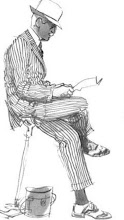
Easter comes early this year, and with it the annual question of when (or if) is it ever appropriate to wear white clothing. Fair Hope, Alabama attorney David Bagwell has settled this issue once and for all with an article titled "The White Shoe Rule and Straw Hat Day". We've printed it here in the past, and will do so in the future. It's printed now in hopes of saving some of you from yourselves.


THE WHITE SHOE RULE AND “STRAW HAT DAY”:

By
David A. Bagwell

Fifty years ago, and more, the tradition in the deep South was that beginning on Easter weekend -- well before what people now call “Memorial Day”-- it became safe to wear white pants and skirts, white shoes and spectators, and a straw hat. I lump all that light-colored stuff together into what I call “The White Shoe Rule”.

Some Southerners today don’t buy that. They say that The White Shoe Rule doesn’t start until what we now call “Memorial Day”. Most of those people seem unusually certain that they know what they are talking about.

My answer to them is that they have gradually become –apparently unknowingly, I’ll charitably grant them that– the pawns and tools of the general Yankee-fication of America. I fully understand that this is a serious charge, but as Martin Luther said, “here I stand; God help me, I can do no other”, except he said it in German.

It’s a serious fashion question, even in this time of war, and sadness, and–their first cousin– presidential politics. Maybe it’s idle and frivolous to speak of the rules of fashion, but even during war and elections, life moves on, and so must we.

So, when may we properly begin --and when must we properly stop-- the wearing of white? Good question.

Do you remember the book The Southern Belle Primer by the wonderful late Marilyn Schwartz, whose subtitle was to the effect that Her Royal Highness Princess Margaret could never get in Kappa Kappa Gamma sorority because she wore white shoes in Texas the wrong time of year? I’m convinced that a lot of people misunderstand all this “White Shoe Rule” stuff, and not just the late Princess Margaret. A lot of us don’t know as much about our dress code history as we should.

Oh, sure; I know that every written source on fashion which might mention it, will say that you cannot wear white or straw hats before “Memorial Day”; we’ll get to all that in a moment. But all those books are written by Yankees. What you will read in those books is just – out with it now – just the Yankee rules. In the South, ours were always different, and they still are, unless we are morphing into Yankees, as some of us are.

Of course nobody should wear white all of the time. In 1880 Mark Twain wrote of his character Colonel Grangerford that “every day of his life he put on a clean shirt and a full suit from head to toe made out of linen so white it hurt your eyes to look at it.” But every day? Even in winter? In deepest winter, now, you’ll obviously make a spectacle of yourself in white. On December 7, 1906, when Mark Twain went to a copyright law hearing in the Capitol in Washington, D.C.– in December in Washington, mind you– he wore a suit of white wool flannels, not white linen. But the ruckus he raised by wearing a white suit in Washington in the winter landed him in stories in the New York Times, Herald, and Tribune the next morning. Of course, his point about copyrights was in the article, too, which just goes to show you that clothing can not only make a fashion statement, it can also help your substantive statement get published. Twain said funereally that “when a man reaches the advanced age of 71 years as I have, the continual sight of dark clothing is likely to have a depressing effect upon him”. And “a group of men in evening clothes looks like a flock of crows, and is just about as inspiring”, he said. But, if you aren’t 71 and you aren’t Mark Twain, and it is not 1906–and I’m not and it isn’t– you must pay some attention to these rules, you know. Which means that you must know what the rules are.
The first thing to understand is that there are EXCEPTIONS to all this White Shoe Rule stuff, no matter when the starting date is.

One exception is "The Southern Resort Exception". At any Southern resort, like Boca Grande or Palm Beach or farther off in Bermudan or Carribean resorts and all that, white clothes and straw hats are ALWAYS allowed, regardless of the season. My father told me that the Yankees who went to the University of Alabama with him in the early 1930s wore white shoes all winter, on the apparent theory that Tuscaloosa was a Southern resort, which is clearly twelve points off true north.

What’s a “Southern resort”, anyway, outside of Boca Grande or something? Well, probably the place where I live– Point Clear on Mobile Bay -- barely qualifies as “a Southern resort”, although locals don’t wear white shoes here in the winter. What about Charleston and Savannah and Mobile? Well, maybe, but that’s pushing it. Here on the Gulf coast in winter the “snowbirds” from Michigan and Ohio and Canada wear shorts all winter visiting here -- and shiny nylon jackets which say things like “UAW Local 312" on the back-- but snowbirds just don’t for my purpose; I mean, they’re just snowbirds, which is what we lawyers call “a lesser-included offense”. To an Englishman, any place where it is warm and not raining at that moment, is apparently considered a “Southern resort”, which is precisely how H.R.H. Princess Margaret got in such hot water out in Texas for wearing white shoes in Dallas before their time– whatever their time is in Dallas.

The second exception is “The Yacht Exception”. I am not too sure of the breadth of this exception, either, never having owned a yacht and all, but I think that weather permitting, you may always wear white clothes on a yacht, at least if you don’t change your own engine oil, and no gentleman does that. This may be a sub-theorem of the Southern Resort Rule, since one always keeps her yacht in the South during the winter, doesn't she? And, speaking of The Late Princess Margaret, since the British Royal family has sent the Royal Yacht BRITANNIA to the wreckers for scrap, I just don’t know where they wear their whites, other than maybe Dallas in a pinch. The picture on my wall of Commodore Vanderbilt on his yacht – and before “The Late Unpleasantness” his yacht was the biggest yacht in the world– shows him in black wool with fur trim, so obviously it is not de rigeur– as we say down home-- that you wear whites on your yacht in winter. What’s a yacht? Well, paraphrase what J.P. Morgan said about “if you have to ask . . . . .”. I do know that none of my little canoes and duckskiffs and kayaks and rowboats and motor skiffs is “a “yacht”, and so mostly I just wear khaki shorts.

OK, exceptions aside, what exactly is The Rule?

Well, everybody agrees on the ENDING date of The White Shoe Rule, namely, that after Labor Day, you cannot wear white pants or suit or shoes, unless you meet one of the exceptions.
It's just the BEGINNING date for The White Shoe Rule that causes the problem.

To Yankees, the rule was always-- at least after Memorial Day was declared, after the Civil War -- that you cannot wear white pants or skirts or suits or shoes until what Yankees have always called “Memorial Day”, which is of course the last Monday in May.

But then that’s Yankees. My research confirms that in general, over the South, Easter weekend – and not Memorial Day-- was the beginning for the White Shoe Rule. Remember that Easter was the day on which boys got a new white linen coat, if their parents could afford one? And white shoes? They didn’t wait until Memorial Day.

That Easter rather than Memorial Day was the starting date for The White Shoe Rule in the South is not surprising, for two reasons. First, the South obviously gets hot earlier than the North does; I mean, what level are we on? Second, what we now call “Memorial Day” was originally set up as a memorial for Union soldiers in the Civil War, and when I grew up it was called “Yankee Memorial Day”. Here in Alabama the Federal workers got a holiday on “Yankee Memorial Day”, but the State workers got the holiday on “Confederate Memorial Day”, which in Alabama was April 26th [The rest of us in the private world always worked on both Yankee Memorial Day and Confederate Memorial Day]. Nobody in the deep South would have dated a fashion requirement or anything else from Yankee Memorial Day; I mean, laese majesty and all that! So, Easter was it.

I told you straight-out my theory that the people who think that the first day of The White Shoe Rule is Yankee Memorial Day rather than Easter, and who are moving the fashion goalposts from Easter to Yankee Memorial Day, are just one small part of the general Yankee-fication of America. National Public Radio no less, certainly an expert on the Yankee-fication of America, reported that Texas singer “Kinky” Friedman of the singing group “Kinky Friedman and the Texas Jewboys”-- Kinky won the “Male Chauvinist of the Year” Award of The National Organization for Women with his song “Put Your Biscuits in the Oven and Get Your Buns Back in Bed”-- ran for governor of Texas in 2006 on the platform “Stop the Wuss-ification of Texas”. Kinky lost, but that is just a small skirmish in the larger battle over the general Yankee-fication of America.

But, for some reason– I don’t know why-- Easter was not necessarily the beginning day for straw hats for men. Strangely and “counter-intuitively”, as intellectuals seem to say, there was a totally separate and clear Southern rule for straw hats, and it certainly wasn’t Yankee Memorial Day, which was far too late to switch to straw hats. There was something called “Straw Hat Day” in the old days when people wore hats, and on “Straw Hat Day” it was like some Fred Astaire musical with a chorus, and everybody in unison– men and women, but mostly men -- all doffed their felt hats and put on their straw hats.

When was “Straw Hat Day”? Well, if you research it on the internet you’ll find that people in the upper South and Maryland seem to think that there was a “National Straw Hat Day” and that it was on May 15th. Well, not so fast.

We had a “Straw hat Day” in Mobile, and in Montgomery where I grew up, and surely in many other towns, but it was not May 15th; instead, it was a moveable feast. “Straw Hat Day” in Mobile was on whatever springtime day the Mayor’s proclamation of “Straw Hat Day” said it would be, but it was always just before Easter, usually on either Maunday Thursday, or the next day on Good Friday, just in time for the spring and Easter– read: white– finery to flower. The earliest recorded Mayor’s proclamation of Straw Hat Day in Mobile that I found during lunch in the City Archives was in 1931.

Why 1931? Well, hard to say for sure, but one clue is that the Mobile Register for March 7, 1931, which said "The first straw hat of 1931 appeared on Royal and Dauphin streets yesterday, far ahead of the official advent of spring. The latest model of 'head-gear' was worn by a stylishly dressed man, who did not seem embarrassed by eyes that stared and comments made as he passed along the avenues". Maybe the notable uncertainty of the proper beginning day for straw hats, so obvious in March of 1931, prompted the male populace to demand that the Mayor set an actual beginning date for straw hats; who knows at this point? While the files are not complete, these proclamations of “Straw Hat Day” seem to have run pretty steadily from 1931 until John Kennedy ran for president in 1960, when fashionable young men decided that fashionable young men simply did not wear hats any more. If fashionable young men don’t wear hats, then there is no need for a “Straw Hat Day”.

These old Mayoral proclamations here of “Straw Hat Day” are wonderful throwbacks to another world of springtimes filled with wisteria and azaleas, usually reciting in multiple “whereases” that “Mobile is a veritable flower garden with the air scented with street perfume and the streets lined with the riotous coloring of floral displays”, that “our birds are singing everywhere and their songs are the harbingers of new life and springtime”, noting the date of the Mobile Bears’ opening game and pointedly proclaiming that the proper hat to be worn at all baseball games “is a STRAW hat” – note that it is not a baseball cap– and declaring “Straw Hat Week”. “All citizens of the city”-- and not just men-- were “urged to put away their winter chapeaux and to replace them with sparkling new STRAW HATS”. So straw hat day was always just before Easter. Attention Yankees and the running dogs of Yankees: “Straw Hat Day” in the South never had anything to do with Yankee Memorial Day.

I’m not the guy to talk about women’s Mardi Gras finery in Mobile and New Orleans, other than admiring it and paying for it, but everybody knows that women beat Easter to the punch by forty or more days during Mardi Gras, wearing light clothes and straw hats.

But, then in the fall, the Southern cities would flip back, on some designated day about a month after Labor Day, proclaimed by the Mayor and City Commission to be called “Felt Hat Day”.
And, it’s worth noting in passing – since it is clearly forgotten by most of us– that there were official Mayoral proclamations banning suits and coats in the daytime in the summer, beginning about July 1st. Apparently the “Coats Off Campaign” in late summer was started by the Junior Chamber of Commerce just after WWII, and by the middle 1950s Southern mayors often proclaimed that beginning on “Sport Shirt Day” on July 1st or 2nd or something, and usually running all summer until the official first day of fall on September 21, “the proper, modest and polite attire for gentlemen in the City [shall] be and the same is hereby declared to be a neat, lightweight sports shirt instead of coat and necktie for all occasions from sunrise to sunset, and also proper evening attire except for formal occasions”. Now, why in the world was that ever abandoned in the South? Obviously the advent of air conditioning nipped it, but still, that is a tradition that Southerners ought to have preserved, just as they ought to have preserved more old buildings and houses and all of that. Here in Fairhope we still have a sportshirt tradition in both the summer and the winter, and we impart this tradition to our sons and grandsons in Homeric song before the fire of an evening. It might be our role to do that now, and so I now heartily recommend to all, wherever they live, that they go back to the sound traditions of their fathers and grandfathers, and not be unsound on the sportshirt question.

Now, admittedly, this fashion stuff was mostly higher- income people in the first place, and whether or not this date was observed by a man plowing a mule –switching his and his mule’s hats from the wool hat to the straw hat– I just cannot say for sure. But I can say for sure that a man who wore a felt hat until Yankee Memorial Day looked pretty strange on a Southern street. Or, a man who even recognized Yankee Memorial Day, for that matter.

But these rules seem to be moving fast. Friends who know, say that at the Fairgrounds in New Orleans, plenty of the horse owners in the winners’ circle wear white suits in the early spring, even shortly after Mardi Gras. Maybe New Orleans always started wearing white after Mardi Gras; I don’t know, or maybe even never stopped wearing white? Is New Orleans a “Southern resort”? But, why-oh-why do New Orleanians have to wear those black shoes and bright shirts and ties with their white suits; it’s Atticus Finch morphing into “Fast Eddie’s Used Cars”, for heavens’ sakes.

The edges of The White Shoe Rule are increasingly ragged. In the women’s fashion field there is some analog to “Moore’s Law” in computers, such that the rapidity of changes in fashion trends tends to multiply by a factor of four every three years, or something. Attractive young women in high fashion who are inexplicably close to me report that “modern fashionistas wear white year-round to get that ‘edgy look’ as they call it”, not following any rule but their own. Examples?

Wearing white leather boots in the winter, for instance; obviously not meant for summer, but still white. The apparent idea of “edginess” is “intentional fashion faux pas”. But, the edgy look of white shoes year round can only be pulled off by those who are, you know–edgy. “On the average woman, it will simply look like someone who didn’t quite know whether it was Easter or Memorial Day yet.” Which is still better than those white patent shoes and belt on Fast Eddie’s used car lot, and all. Whether white rubber boots on a shrimper are “edgy” or not, I’ll let you decide; I mean, some of these questions are pretty far out.

Well, I don’t have a yacht, and I’m not too sure this is a southern resort, but for my money, white clothes are OK from Easter through Labor Day, on clear days anyway, and being reasonable about it, like “OK at garden parties but not funerals”. Suit yourself, but if you don’t agree, then you may well be a Yankee.

David Bagwell lives in Point Clear, Alabama, and has his own "White Shoe Law Firm" in Fairhope. In almost six decades he has never lived outside the South, although he once spent most of a year traveling around the world on a Fellowship to study international business, during which he almost always wore a suit, but never a white suit or white shoes, since the message of a white suit in -say-Rangoon or Calcutta, or even Marseilles, might convey a different messsage than intended.

Thank you again David.

Toad

PS: An email from David says the Straw Hat Day in Fairhope is next Thursday

Wednesday, April 13, 2011

The White Shoe Rule and Straw Hat Day


Chicago Sun Times photo

Much has been written lately about what is and what isn't appropriate Easter attire. Easter is late this year, and the weather likely comfortable yet rules are necessary and do apply.

A while back, Duck, remember Duck?, copied this article from the blog "Southern Culture" and posted it on Channeling Bunny. Southern Culture has since taken the link down, and with it the story on Channeling Bunny.

So, I wrote the author, Fairhope, Alabama attorney David A. Bagwell for permission to republish his work. Ever the gentleman, Mr. Bagwell gave his kind consent.

This boys and girls, is the definitive White Shoe Rule, revised for 2011, all else are pretenders.

Thank you David, and Duck.

Toad
(reprinted with permission on the near occasion of our 1000th post)

Carolina Cup Day, 1930


THE WHITE SHOE RULE AND STRAW HAT DAY

By

David A. Bagwell


Fifty years ago, and more, the tradition in the deep South was that beginning on Easter weekend -- well before what people now call “Memorial Day”-- it became safe to wear white pants and skirts, white shoes and spectators, and a straw hat. I lump all that light-colored stuff together into what I call “The White Shoe Rule”.

Some Southerners today don’t buy that. They say that The White Shoe Rule doesn’t start until what we now call “Memorial Day”. Most of those people seem unusually certain that they know what they are talking about. But Southern tradition suggests that they are wrong.

It’s a serious fashion question, even in this time of war and economic travail. Maybe it’s idle and frivolous to speak of the rules of fashion anytime, some think, but even during war and elections and recession, life moves on, and so must we.

So, when may we properly begin --and when must we properly stop-- the wearing of white? Good question.

Do you remember the book The Southern Belle Primer by the wonderful [late] Marilyn Schwartz, whose subtitle was to the effect that Her Royal Highness Princess Margaret could never get in Kappa Kappa Gamma sorority because she wore white shoes in Texas the wrong time of year? I’m convinced that a lot of people beyond princesses misunderstand all this “White Shoe Rule” stuff. A lot of us don’t know as much about our dress code history as we should, or as much as we think for that matter.

Oh, sure; I know that every written source on fashion which might mention it, will say that you cannot wear white or straw hats before “Memorial Day”; we’ll get to all that in a moment. What you will read in those books is just – out with it now – just the Yankee rules. It’s ok for them to have their rules, but here in the South, ours were always different.

Of course nobody should wear white all of the time. In 1880 Mark Twain wrote of his character Colonel Grangerford that “every day of his life he put on a clean shirt and a full suit from head to toe made out of linen so white it hurt your eyes to look at it.” But every day? Even in winter? In deepest winter, now, you’ll obviously make a spectacle of yourself in white. Mark Twain did. On December 7, 1906, when Mark Twain went to a copyright law hearing in the Capitol in Washington, D.C.– in December in Washington, mind you– he wore a suit of white wool flannels, not white linen. But the ruckus he raised by wearing a white suit in Washington in the winter landed him in stories in the New York Times, Herald, and Tribune the next morning. Of course, his point about copyrights was in the article, too, which just goes to show you that clothing can not only make a fashion statement, it can also help your substantive statement get published. Twain said funereally that “when a man reaches the advanced age of 71 years as I have, the continual sight of dark clothing is likely to have a depressing effect upon him”. And “a group of men in evening clothes looks like a flock of crows, and is just about as inspiring”, he said. But, if you aren’t 71 and you aren’t Mark Twain, and it is not 1906–and I’m not and it isn’t– you must pay some attention to these rules, you know. Which means that you must know what the rules are.

The first thing to understand is that there are EXCEPTIONS to all this White Shoe Rule stuff, no matter when the starting date is.

One exception is "The Southern Resort Exception". At any Southern resort, like Boca Grande or Palm Beach or farther off in Bermudan or Carribean resorts and all that, white clothes and straw hats are ALWAYS allowed, regardless of the season. My father told me that the Northerners who went to the University of Alabama with him in the early 1930s wore white shoes all winter, on the apparent theory that Tuscaloosa was a Southern resort, which is clearly twelve points off true north.

What’s a “Southern resort”, anyway, outside of Boca Grande or something? Well, probably the place where I live– Point Clear on Mobile Bay -- barely qualifies as “a Southern resort”, although locals don’t wear white shoes here in the winter. What about Charleston and Savannah and Mobile? Well, maybe, but that’s pushing it. My correspondent in Charleston reports that a man dressed in all white, especially if any of it is patent leather, tends to be called there “full Cleveland”. Here on the Gulf coast in winter the “snowbirds” from Michigan and Ohio and Canada wear shorts all winter visiting here -- and shiny nylon jackets which say things like “UAW Local 312" on the back-- but snowbirds just don’t count for my purpose; I mean, they’re just snowbirds, who have their own rules. To an Englishman, any place where it is warm, and not raining at that moment, is apparently considered a “Southern resort”, which is precisely how H.R.H. Princess Margaret got in such hot water out in Texas for wearing white shoes in Dallas before their time– whatever their time is in Dallas. There are wonderful photos of Winston Churchill in a white suit, often wearing his favorite white panama Stetson in the “Open Road” pattern; you know, the pattern which in gray was worn by LBJ and by every single graduate of the Colorado School of Mines. But whites in London? A British judge told me once that, years before, he looked out his office window one summer day and saw his boss wearing a white suit and white panama hat in London, and that he involuntarily exclaimed at the sight “A Panamanian ponce!” [“ponce” of course being English slang for procurers for pay of the favours of exceptionally fast females].

The second exception is “The Yacht Exception”. I am not sure of the breadth of this exception, either, never having owned a yacht and all, but I think that weather permitting, you may always wear white clothes on a yacht, at least if you don’t change your own engine oil, and no gentleman does that. This may be a sub-theorem of the Southern Resort Rule, since one always keeps her yacht in the South during the winter, doesn't she? And, speaking of The Late Princess Margaret, since the British Royal family has sent the Royal Yacht BRITANNIA to the wreckers for scrap, I just don’t know where they wear their whites, other than maybe Dallas in a pinch. The picture on my wall of Commodore Vanderbilt on his yacht – and before “The Late Unpleasantness” his yacht was the biggest yacht in the world– shows him in black wool with fur trim, so obviously it is not de rigeur that you wear whites on your yacht in winter. What’s a yacht? Well, paraphrase what J.P. Morgan said about “if you have to ask . . . . .”. I do know that none of my little canoes and ducking skiffs and kayaks and rowboats and motor skiffs is “a “yacht”, and so mostly I just wear khaki shorts.

OK, exceptions aside, what exactly is The Rule?

Well, everybody agrees on the ENDING date of The White Shoe Rule, namely, that after Labor Day, you cannot wear white pants or suit or shoes, unless you meet one of the exceptions.

It's just the BEGINNING date for The White Shoe Rule that causes the problem.
To Northerners, the rule was always-- at least after Memorial Day was declared, after the Civil War -- that you cannot wear white pants or skirts or suits or shoes until what Northerners have mostly called “Memorial Day” [earlier perhaps “Decoration Day”], which is now of course the last Monday in May.

But then that’s Northerners. My research confirms that in general, over the South, Easter weekend – and not Memorial Day-- was the beginning for the White Shoe Rule. Remember that Easter was the day on which boys got a new white linen coat, if their parents could afford one? And white shoes? They didn’t wait until “Memorial Day”.

That Easter rather than Memorial Day was the starting date for The White Shoe Rule in the South is not surprising, for two reasons. First, the South obviously gets hot earlier than the North does; I mean, what level are we on? Second, what we now call “Memorial Day” was originally set up as a memorial for Union soldiers in the Civil War, and when and where I grew up in Alabama, it was called “Yankee Memorial Day”. Here in Alabama the Federal workers got a holiday on “Yankee Memorial Day”, but the State workers got the holiday on “Confederate Memorial Day”, which in Alabama is April 25th [The rest of us in the private world, fusionists like L.Q.C. Lamar in John F. Kennedy’s book Profiles in Courage, always worked on both Yankee Memorial Day and Confederate Memorial Day]. Nobody in the deep South would have dated a fashion requirement or anything else from Yankee Memorial Day. Easter was it.

My theory is that the people who think that the first day of The White Shoe Rule is Yankee Memorial Day rather than Easter, and who are moving the fashion goal posts from Easter to Yankee Memorial Day, are just one small part of the general Yankee-fication of America. National Public Radio, no less, reported that Texas singer “Kinky” Friedman of the singing group “Kinky Friedman and the Texas Jewboys”-- Kinky won the “Male Chauvinist of the Year” Award of The National Organization for Women with his song “Put Your Biscuits in the Oven and Get Your Buns Back in Bed”-- ran for governor of Texas in 2006 on the platform “Stop the Wuss-ification of Texas”. Kinky lost, but that is just a small skirmish in the larger battle.

But, for some reason– I don’t know why-- Easter was not necessarily the beginning day for straw hats for men. Strangely and “counter-intuitively”, as intellectuals seem to say, there was a totally separate and clear Southern rule for straw hats, and it certainly wasn’t Yankee Memorial Day, which was far too late to switch to straw hats. There was something called “Straw Hat Day” in the old days when people wore hats, and on “Straw Hat Day” it was like some Fred Astaire musical with a chorus, and everybody in unison– men and women, but mostly men -- all doffed their felt hats and put on their straw hats.
When was “Straw Hat Day”? Well, if you research it on the internet you’ll find that people in the upper South and Maryland seem to think that there was a “National Straw Hat Day” and that it was on May 15th. Well, not so fast.

We had a “Straw hat Day” in the cities in Alabama where I grew up, and surely in many other towns, but it was not May 15th; instead, it was a moveable feast. “Straw Hat Day” in Mobile was on whatever springtime day the Mayor’s proclamation of “Straw Hat Day” said it would be, but it was always just before Easter, usually on either Maunday [or “Holy”] Thursday, or the next day on Good Friday, just in time for the spring and Easter– read: white– finery to flower. The earliest recorded Mayor’s proclamation of Straw Hat Day in Mobile that I found in the City Archives was in 1931.

Why 1931? Well, it’s hard to say for sure, but one clue is that the local paper, the Mobile Register for March 7, 1931, said "The first straw hat of 1931 appeared on Royal and Dauphin streets yesterday, far ahead of the official advent of spring. The latest model of 'head-gear' was worn by a stylishly dressed man, who did not seem embarrassed by eyes that stared and comments made as he passed along the avenues". Maybe the uncertainty of the proper beginning day for straw hats in March of 1931–sounds to me like the first day of Spring on March 20th tended to be the date to most people – prompted the male populace to demand that the Mayor set a clear official beginning date for straw hats; who knows at this point? While the files are not complete, these proclamations of “Straw Hat Day” seem to have run pretty steadily from 1931 until John Kennedy ran for president in 1960, when fashionable young men decided that fashionable young men simply did not wear hats any more. If fashionable young men don’t wear hats, then there is no need for a “Straw Hat Day”.

These old Mayoral proclamations here of “Straw Hat Day” are wonderful throwbacks to another world of springtimes filled with wisteria and azaleas, usually reciting in multiple “whereases” that “Mobile is a veritable flower garden with the air scented with street perfume and the streets lined with the riotous coloring of floral displays”, that “our birds are singing everywhere and their songs are the harbingers of new life and springtime”, noting the date of the Mobile Bears’ opening baseball game and pointedly proclaiming that the proper hat to be worn at all baseball games “is a STRAW hat” – note that it is not a baseball cap– and declaring “Straw Hat Week”. “All citizens of the city”-- and not just men-- were “urged to put away their winter chapeaux and to replace them with sparkling new STRAW HATS”. So straw hat day was always just before Easter.“Straw Hat Day” in the South never had anything to do with Yankee Memorial Day.

I’m not the guy to talk about women’s Mardi Gras finery in Mobile and New Orleans, other than admiring it and paying for it, but everybody knows that women beat Easter to the punch by forty or more days during Mardi Gras, wearing light clothes and straw hats.
But, then in the fall, the Southern cities would flip back, on some designated day about a month after Labor Day, proclaimed by the Mayor and City Commission to be called “Felt Hat Day”.

And, it’s worth noting in passing – since it is clearly forgotten by most of us– that back before air conditioning became general, there were official Mayoral proclamations banning suits and coats in the daytime in the summer, beginning about July 1st. Apparently in Mobile around which I live and work, the “Coats Off Campaign” in late summer was started by the Junior Chamber of Commerce just after WWII, and by the middle 1950s Southern mayors often proclaimed that beginning on “Sport Shirt Day” on July 1st or 2nd or something, and usually running all summer until the official first day of fall on September 21, “the proper, modest and polite attire for gentlemen in the City [shall] be and the same is hereby declared to be a neat, lightweight sports shirt instead of coat and necktie for all occasions from sunrise to sunset, and also proper evening attire except for formal occasions”. In Tuscaloosa, Alabama in the mid-1950s, the Mayor in the third week in April “proclaimed the opening of the sport shirt, straw hat and sport shoe season for the comfort of the city’s male population”, some three months before they did that here on the coast.

Now, why in the world was all of that ever abandoned in the South? Obviously the advent of air conditioning nipped it, but still, that is a tradition that Southerners ought to have preserved, just as they ought to have preserved more old buildings and houses and all of that. Here in Fairhope we still have a sportshirt tradition in both the summer and the winter, and we impart this tradition to our sons and grandsons in Homeric song before the fire of an evening. Now, admittedly, this fashion stuff was mostly higher- income people in the first place, and whether or not this date was observed by a man plowing a mule –switching his and his mule’s hats from the wool hat to the straw hat– I just cannot say for sure. But I can say for sure that a man who wore a felt hat until Yankee Memorial Day looked pretty strange indeed on a Southern street. So did a man who even recognized Yankee Memorial Day, for that matter.

But these rules seem to be moving fast. Friends who know, say that at the Fairgrounds in New Orleans, plenty of the horse owners in the winners’ circle wear white suits in the early spring, even shortly after Mardi Gras. Maybe New Orleans always started wearing white after Mardi Gras; I don’t know, or maybe even never stopped wearing white? Is New Orleans a “Southern resort”? But, why-oh-why do New Orleanians have to wear those black shoes and bright shirts and ties with their white suits; it’s Atticus Finch morphing into “Fast Eddie’s Used Cars”, for Heavens’ sakes.

The edges of The White Shoe Rule are increasingly ragged. In the women’s fashion field there is some analog to “Moore’s Law” in computers, such that the rapidity of changes in fashion trends tends to multiply by a factor of four every three years, or something. Attractive young women in high fashion who are inexplicably close to me report that “modern fashionistas wear white year-round to get that ‘edgy look’ as they call it”, not following any rule but their own. Examples? Wearing white leather boots in the winter, for instance; obviously not meant for summer, but still white. The apparent idea of “edginess” is “intentional fashion faux pas”. But, the edgy look of white shoes year round can only be pulled off by those who are, you know–edgy. “On the average woman, it will simply look like someone who didn’t quite know whether it was Easter or Memorial Day yet.” Which is still better than those white patent shoes and belt on Fast Eddie’s used car lot, and all. Whether white rubber boots on a shrimper are “edgy” or not, I’ll let you decide; I mean, some of these questions are pretty far out.

Well, I don’t have a yacht, and I’m not too sure this is a southern resort, but for my money, white clothes are ok from Easter through Labor Day, on clear days anyway, and being reasonable about it, like “ok at garden parties but not funerals”. Suit yourself, but if you don’t agree, then you must be a Yankee. Which is ok. But let’s just recognize the possibility of diversity on this question.


David Bagwell lives in Point Clear, Alabama, and has his own "White Shoe Law Firm" in Fairhope. In almost six decades he has never lived outside the South, although he once spent most of a year traveling around the world on a Fellowship to study international business, during which he almost always wore a suit, but never a white suit or white shoes, since the message of a white suit in -say-Rangoon or Calcutta, or ever Marseilles, might convey a different message than intended.

Friday, September 10, 2010

The Old Timey Southern Dove Shoot

Today, we celebrate dove season, the camaraderie and competition of the hunt, the enjoyment of watching field dogs working as they were bred to do, a walk in the outdoors and the art of male bonding.

Our intrepid guide to the outdoors Mr. David Bagwell, late of Fairhope, Alabama is todays narrator. Photos provided by the author.

The Old Timey Southern Dove Shoot


In the deep South there’s one thing that says “early fall” even when it’s really still summer: the Southern dove shoot. In what to a Gulf Coast Southerner is “the upper South”– oh, places like South Carolina, Tennessee and North Mississippi and North Alabama [ok, ok; so that’s not “the upper South” to just everybody]– Southern-style dove shoots start about Labor Day. As we all know, Labor Day is also when you put away your white linen suit and seersuckers and white bucks and stuff, even if not yet your Borsalino Panama. And get out your shotgun, if you are so inclined, as I am.

The Southern dove shoot. Not everybody likes it or even gets it, but I do.

Not long ago I bought a wonderful English book called “The Best Shoots”, about bird shoots in England and all that. Some really great stuff, about shoots, driven grouse and pheasants, in Edwardian times and now. I recommend it highly. Among other things you’ll be amazed by Prince Duleep Singh, who was Queen Victoria’s pet Maharajah and Godson, last Asian owner of the Koh-i-Noor diamond, now in Victoria’s Empire Crown, who loved the Victorian shoot. A great book with some great stories [uncompensated endorsement].

The surprising thing about that book, which took a little while to grow on me, is how much the great shoots of England are like the old-time Southern dove shoots. Maybe it’s this way in the rest of the country; I don’t know, maybe I just THINK it’s a Southern thing. Maybe it is a hunter thing rather than a Southern thing.

Speaking of which, this isn’t the essay in which to explain or debate the killing of birds by hunters. If you don’t want to do it, that’s fine with me. But I do. Unlike some of the great outdoorsmen such as Aldo Leopold and Ortega y Gasset, and Guy de la Valdene, I don’t offer a public explanation for why I hunt. It isn’t Celtic bloodlust; I don’t get a semi-sexual thrill from the kill or anything, but it is a lot of fun and it is satisfying, and it produces good birds for the table. I think it’s actually something traditionally within humans, maybe mostly within men. I cannot even explain it or understand it, but on the other side of the coin I have reverence for the birds I kill and eat, and I support conservation efforts for them.


And the older I get, the more I like bird hunting, and when I go bird hunting, I just feel very traditionally Southern. In my own case, which isn’t universal by any means, it’s also a literary kinship with the past. I’m the guy in your English class who read Faulkner’s The Bear not for the academic symbolism that the geek professor professed to see in it, but to learn how they hunted in the old Delta. Each autumn I re-read some of the great literature of bird shooting, by people like Nash Buckingham of Memphis, Vereen Bell of South Georgia, Havilah Babcock of South Carolina, and some Yankees too, like the great old-shoe Gene Hill. And especially “Dog and Gun” from 1856, that entirely serious work by the humorist of the old South Johnson Jones Hooper, Alabama lawyer and editor and Indian historian and hunter, which I discovered forty-four years ago in the rare book room of the Vanderbilt library, writing a paper on Hooper. I love all this on multiple levels, partly literary. But I don’t mention that on Southern dove shoots.

It’s also a lot of fun to be around the other people. In the old days these would have all been men, but in my newest dove club there is a husband-and-wife who joined to take their son out; the wife is a fellow lawyer whose father the judge, now sadly deceased, was one of the best dove shots I ever saw.

First you have to dress for the occasion, same as any occasion. And with some dove shoots there is fashion almost as strict as any in England, if not so stodgy. In some dove shoots people wear camouflage clothes, and in some they don’t. This doesn’t seem to be so much a geographical difference as maybe what I would never consent to call a class difference [but like Byron’s Julia, whilst saying “I shall ne’er consent”– I consented]. In my crowd almost nobody wears camouflage. We wear mostly dark khaki-colored or brown clothes; nothing too fancy, just understated. Nobody ever mentions the dress differences, but at my shoots they mostly show up in non-camouflage.

And you have to have your shotgun of course. In the old days of the twenties and thirties most everybody would have had a side-by-side double-barrel shotgun, mostly of American make; a Winchester 21 maybe, or an L.C. Smith field grade, or a Parker or a LeFever. In the late twenties and early thirties automatics came in, often in sixteen gauge, like the Belgian Browning humpback “Sweet Sixteen”, a beautiful gun. There always were some slick-shooting pumps, like the classic Winchester Model 12. And later came European over-and-unders like the Beretta Silver Pigeon, and European automatics like Benelli and others, maybe in twenty gauge. A decade or so ago there was a big move back to side-by-side doubles, usually in twenty gauge or maybe 28 gauge, and rarely– depending on the wealth of the shooters– maybe an English or Spanish best double game gun. There might be some quiet and modest talk and comparison about the guns, but very little or no bragging.

At an old-timey dove shoot you normally meet your friends near the field in the early mid-day. If you are lucky a good lunch will be there, especially on opening day. Some of my memorable opening day dove shoot lunches have included fried mullet and greens, gumbo with crab bodies in it, and grilled Mexican dove breasts with cream cheese and jalepeno, wrapped in bacon. Another was in a cottage on Mobile Bay, with white-coated service and fried chicken and sandwiches. There might be a Bloody Mary or a cold beer, but drinking is not a major part of this deal. There is the safety issue with drinking, of course, as in any endeavor, but good hunters know that alcohol affects shooting skills, and dove shooting is a game almost entirely based on skill.

You might go into the dove field about two o’clock, carrying your gun unloaded with an open breech. Usually you go too early. Old Captain Jackson– a retired towboat owner who pulled “rafts of timber” [log rafts] down the river in the old days– taught me memorably that “doves don’t fly ‘til the school bus runs”, at three p.m. to be precise. Good advice, generally, with some exceptions.

When everybody is safely in the field a truck horn is blown and shooting can start.

“The dove field”– what is that? Well, it has changed some over the years, but basically it is a large farm field, usually at the edge of town, with shooters stationed around the trees and fences on the perimeter, and some shooters in “dove blinds” in the middle of the field. A “dove blind” is camouflage cloth wrapped around some four-foot stakes in the ground, in my own case the stakes being flounder gigs which I also use to gig flounder in the shores during Jubilees on Mobile Bay.

The doves? They are Mourning Doves, near town with a few non-native [and non-counted] tough big Eurasian Collared Doves in the mix, the lighter gray ones which sound high and hoarse like a New Year’s Eve blown roll-out whistle. Don’t dare shoot the small ground doves; they are protected. Or the small hawks that look like doves.

The reason the doves are there is simple: they came for dinner. Just what the doves are coming to eat depends on a variety of factors. Early in the year they may be coming to glean the remains of the harvest, of corn or peanuts, which fell on the ground during “the normal agricultural activity” of harvest. A little later they may be coming in for “the normal agricultural activity” of sewing of seed, in a permitted way the date and manner of which is set out by the local state agricultural college. Whatever it is, it must be followed precisely on pain of arrest because ever since the Migratory Bird Treaty between the U.S. and Canada came into effect just after The Great War to End All Wars, “baiting” of doves has been illegal. A “normal agricultural practice” is fine, but not baiting, and the line can be fine indeed. Since thirty years ago I was a judge who tried a lot of dove baiting criminal cases at the Federal Court in South Alabama, a lot of my friends ask me very detailed questions about the narrow line at the interface between “a normal agricultural practice”, which is legal, and baiting, which is a federal and state crime. Questions like “how many times can you re-sow wheat if your crop fails?”, asked not by a Kansas farmer, but by the lawyer or the car dealer or somebody with no dirt under his fingernails. The mere asking of the question usually answers it.


A crop planted and manipulated purely for the doves to eat is not “bait”, but there are some ragged edges to that rule as usual. Around these parts a sunflower crop is great, or a millet field left there and run over.

But bait sure works, and so there is real and illegal “baiting” going on in some places. In the olden days cracked corn was typical. When I was a judge they tried a baiting case before me but nobody ever said exactly what the bait was– the defendant didn’t want to know, and the prosecutors wanted to lure me into it like as the bait lured the doves. I asked innocently enough, “well, what WAS the bait?” The game warden on the witness stand smiled, thought “well, finally!” and said “Judge, the bait was ‘Uncle Ben’s Converted Rice’!” “Uncle Ben’s Converted Rice” on the dove field was not a “normal agricultural use”: GUILTY!

Ideally the birds do fly and the shooters can hit them. The limit may be twelve or fifteen birds, but not everybody gets the limit. Those who get the limit early, walk back to the staging area, with the act of walking back in quiet modesty maybe almost bragging a little on their shooting skill. Finally about 4:30 or so, or five, somebody blows another truck horn and everybody unloads and opens the gun’s breech and walks in or waits on a ride.

Afterward, standing around the trucks or cars, the shooters may share a cold beer or a taste of whiskey, water the dogs, talk quietly, try to avoid bragging, and give somebody a little grief about something that happened that day. Usually the doves are still flying over and people point and smile. Birds may be shared around among those who didn’t get quite enough, almost always oblivious to the complexities of the legal requirements for doing that.

That’s about it. “The Old Timey Southern Dove Shoot”. And what a lot of fun it can be, in the early fall.


David A. Bagwell

Thursday, August 12, 2010

Jubilee

Friend, and occasional contributer to the pages, David Bagwell, a lifelong Alabaman, currently practicing law in his beloved Fairhope has sent this vignette of life on the Gulf Coast. I hope you enjoy.


We had a “Jubilee” this morning at Point Clear on the Eastern Shore of Mobile Bay, Alabama.


Point Clear has been a summer resort since about 1826, when Mobilians came by steamboat to avoid the stagnant heat of the city, and at least since then “Jubilees” have been locally famous. It’s a unique natural phenomenon in which very early on rare mostly-August mornings, for a very short time, lots of flounder and crabs and shrimp and stingrays and mullet and other fish swim right up to the very edge of the beach, where a wading fisherman can net or gig a limit of fish and just about all she can use of the rest of the creatures.


Mobile Bay is a brackish [mixed salt and fresh water] estuary, and marine Scientists think the “Jubilee” results from lower-oxygen salt water coming in with the rising tide into more highly-oxidized fresher water, and the salty water pushes before it the bottom-dwelling species until they get right up on the beach and have nowhere else to go, and lie there in lethargy. Not just everybody knows that the Gulf of Mexico has only one daily high and one low tide, for unusual hydrologic reasons; whether this contributes to the phenomenon is hard to say.


Old-timers know “the signs”, and “the signs” are the things which keep the water calm and not oxygenated: an East wind off the shore; an evening rain leaving the water calm; and hot weather. Some people get out of bed several times during a likely night, to check for one; some people might even stay out most of the night to check regularly.


In the old days, very early in the morning or late at night the cry would go out: “Jubilee!”, and in times before air conditioning, most everybody would hear it and wake up and go out. Sometimes people would ring a bell. Nowadays, it is more common to make a few discreet calls on a cell phone to friends who really want to come. Not just everybody wants to get out of bed at 4:00 AM just to get a bunch of fish and crabs that have to be cleaned before work or play.


The traditional equipment includes a “flounder gig” or just “gig”, which is a spear with one single [usually un-barbed] steel spike; the frog-gigging type would work, but would make thrice as many holes, with three barbs to boot. Also necessary is “a floundering light” [a gaslight with twin mantles and a shiny concave back reflector, to see into the water], a “crab net” on a pole, and some container in which to put the treasures: a washtub or a canoe or a kayak or a plastic bucket or a long fish stringer, pulled behind like a surf caster does it, at least where the sharks won’t get him.


This phenomenon might be unique to “the Eastern Shore” of Mobile Bay, Alabama, on the Gulf Coast [attention Marylanders: other bays than the Chesapeake also have “the Eastern Shore”; fact is, a chunk of crabs sold in and from Maryland actually come from “the Eastern Shore” of Mobile Bay]. We sometimes hear that a “Jubilee” happens someplace in Burma, where the dawn also comes up like thunder oe’er the bay, but evidence of that is at best third- hand hearsay, which puts it even below the dreaded level “ancedotal” which, say the scientists, is mostly worthless as evidence, even though “anecdotal” evidence is fully admissible in Court and is used everyday by everybody to make important personal decisions.


Until maybe 2008 there wasn’t even a limit on the Jubilee flounder, but now a Jubilee fisherman with a gig must have a saltwater fishing license and must obey the limit: twelve, and the size minimum: twelve inches.


Why do it? Well, it’s a lot of fun, and it’s communal. And there is nothing like ending up with several gallon-sized plastic zipper bags full of shrimp, crab bodies and claws, and flounder filets or bodies. Boiling the crabs and cleaning the fish is not so bad, and there is still a legend of the local chef who would clean his friend’s flounders just to end up with the carcasses for fish stock for his restaurant.


“Jubilee!” It’s one wonderful thing about August, on “the Eastern Shore”. Of Mobile Bay, Alabama.


David A. Bagwell

LAT/LON: N 30 ̊31'21", W 87 ̊54'10"

web site: www.bagwellesq.com


On a personal note, Happy 10th. Anniversary to #1 Son and his bride Amy.

Toad

Monday, May 31, 2010

A History Lesson

Mr. David Bagwell who presented the definitive White Shoe Rule has once again submitted for our elucidation, a learned study of the relationships between his own state's flag, the Scottish flag, and the Russian flag.

Very few Russians show up here, but we are long on Scots. Native Alabaman's are few on the ground, and rarely pop in. For your consideration, I present Mr. Bagwell.


THE ALABAMA FLAG, THE CROSS OF ST. ANDREW,
KING ANGUS, AND KING ATHELSTAN
By
David A. Bagwell

There was no Alabama state flag from the founding of Alabama in 1819 until 1861, when Alabama seceded from the Union, and on January 11, 1861 the Secession Convention adopted as a state flag(1)one designed by some Montgomery women.

We didn’t have a state flag again until 1895, when a statute(2)adopted the present Alabama state flag, the design of which is set out by statute, and the statute says simply “The flag of the state of Alabama shall be a crimson cross of St. Andrew on a field of white. The bars forming the cross shall be not less than six inches broad, and must extend diagonally across the flag from side to side.” The statute does not say anything about the Confederate battle flag, but in public grade school in the early 1950s I was taught that the state flag is “reminiscent of the Confederate flag”.

The Confederate Battle Flag contains the cross of St. Andrew. It is not easy to find out just why the Confederate Battle Flag contains the Cross of St. Andrew; if you type into your web browser anything containing the words “Confederate Battle Flag” you don’t get much useful information; just a whole lot of electronic hissing which is either politically- correct, or politically-incorrect, depending upon your point of view.

Why did the Confederate Battle Flag contain the cross of St. Andrew? I don’t know for sure, but I have a theory. Most Southerners [or, “Southrons” as they were wont to call themselves before The Late Unpleasantness] were Scots [or “Ulster Scots” or Scotch-Irish, who were lowland Scots who first went to Ulster in Northern Ireland to work on flax plantations or linen mills, and then left when the Church of England began to require tithes of everybody and the land rent went up quickly and significantly, “the rack rent”]. And, one scholar(3)has a remarkably catchy theory that the only way to understand the difference between Southerners and Northerners is to understand that Southerners are Celts [Irish and Scotch] and Northerners are Englishmen.

Makes sense to me, when you read it. Undoubtedly the legends of the Scots were a major theme in antebellum Southern history. So, the legend is that in putting the cross of St. Andrew in the Confederate battle flag, the Southrons were honoring and invoking their ancestors, the wild and tough Scots.

So, that still does not answer why the flag of Scotland(4)has the Cross of St. Andrew -- a sky-blue or bright- azure background with a white cross in it, the cross of St. Andrew, sometimes called “the saltire (5)cross”. Oh, you know the story; the flag of England had the cross of St. George– vertical and horizontal members– while the flag of Scotland had the cross of St. Andrew, the saltire cross– and they put them both together upon the Union of England and Scotland(6), and naval vessels flew “The Union jack ”(7), with both crosses superimposed, and later, upon union with Ireland, they added a white saltire cross, supposedly to represent Ireland. But, you knew that.

OK, so what gives with the cross of St. Andrew in the national flag of Scotland?
And, why(8)is the Cross of St. Andrew – a blue cross on a white background--the flag of the Russian Navy, the flag which they call the “Andreyevski flag”, from the time of Peter the Great to the Revolution in 1917, and from the dissolution of the USSR in 1992 until now? Why do Alabama, Russia, and the Confederate States of America use the same symbol in their flags, now?

The cross of St. Andrew is, naturally enough, named for St. Andrew, who was the brother of St. Peter and was fishing with Peter when they both became disciples of Jesus and “Fishers of Men”. According to tradition, after Pentecost Andrew became a missionary to Asia Minor, Macedonia and southern Russia, and in 70 A.D. [or, “C.E.” as the secularists would have us say, for “common era”] was martyred in Patras, Greece. He is to this day patron Saint of Greece, Russia and the Ukraine.

St. Andrew was in Patras(9), Greece, during Nero’s time, when he fatally offended the Roman Proconsul Aegaetes in Patras by (1) curing the Proconsul’s wife Maximilla, and –maybe more importantly– (2) convincing her to adopt a lifestyle of sexual abstinence [St. Andrew was supposed to have been big on sexual abstinence], and (3) making the Proconsul’s brother the first Bishop of Patras. The Proconsul, highly incensed by some or all of this, sentenced St. Andrew to die, and supposedly Andrew was crucified by being placed on an X-shaped cross, which the Romans apparently called “crux decusseta”, which means – tah-DAH! -- “cross shaped like an ‘X’”. Latter-day Confederate patriots get all upset when you say that the Confederate flag had an “X-shaped cross on it”, and they say haughtily that “it is the cross of St. Andrew!”, but heck, what the Romans called the cross upon which they crucified St. Andrew was “the X-shaped cross”; I mean, come on, now. The Romans knew their crosses, and stuff.

St. Andrew was buried in Patras with full honors, and his grave became a shrine.

OK, so, why then is the cross of St. Andrew in the Scots flag? Well, because St. Andrew is the patron Saint of Scotland.

Howcome is that? Well, this all has to do with relics and visions and stuff.

One theory(10)is the Holy Relic theory. St. Andrew’s bones were interred in Patras, and three centuries later Constantine the Great, Emperor of Rome and the guy who presided over the Council of Nicea(11) in what we now call Turkey, just across from Constantinople, and especially his mother St. Helena [whose husband had been Emperor, too, but he abandoned her for a politically-powerful woman] developed a great interest in Christian holy relics. Now, this was a time only about 300 years or so after Jesus, and it wasn’t all that hard that early to find holy relics. St. Helena hired some men who found three old crosses in the ground at the foot of Golgotha, where Jesus was crucified [promptly declared “The True Cross” of legend] and she and Constantine also had the bones of St. Mark brought to Constantinople [later to be stolen during the Crusades from the Turks and hidden in a barrel of “unclean” pig lard which the Moslem Turks would not touch, and taken to St. Mark’s in Venice] and she and Constantine set their eyes on the bones of St. Andrew, up in Patras, Greece, in order to move them to Constantinople, his capital of the Eastern Roman Empire.

The Scots theory is that some guy named St. Rule or St. Regulus [who was either an Irish assistant of St. Columba or a Greek monk, depending upon whom you believe] was directed by an Angel to take the bones of St. Andrew “to the ends of the earth” for safekeeping. St. Rule took a tooth, an arm bone, a kneecap and some finger bones from St. Andrew’s tomb [the rest were taken to Amalfi, Italy by the French later(12) ] and took them to the “ends of the earth”, which was Scotland, naturally. St. Rule was shipwrecked on Scotland and came ashore at a Pictish [the Picts were an early Scots tribe] settlement which is now called, naturally, “St. Andrews” in Scotland, the home of golf, and of the place where Queen Elizabeth’s grandson Prince Harry went to college. Maybe St. Andrew is also the Patron Saint of golf, except for the abstinence thing.

Whatever the story on how they got to Scotland, the relics of St. Andrew were in the chapel which was specially constructed for that purpose by the Pictish king Angus or Ungus– Angus mac Fergus-- who reigned from 831-861. This chapel was replaced by the Cathedral of St. Andrews in 1160, and St. Andrews [at some point they dropped the apostrophe from the apostle] became the religious capital of Scotland, and a great center for medieval pilgrims. Nobody knows exactly what happened to the relics, but during the Scottish reformation [you know; Presbyterians and simplicity and all that] likely they were destroyed or something. The place where they were kept in the cathedral is now marked by a plaque in the ruins.

But, back to King Angus, The High King of Alba, Angus mac Fergus. Aided by Scots, Angus went on a punitive raid South across the border into Northumbria, but they were pursued and confronted by a larger force of Angles and Saxons under the first Anglo-Saxon King of England, Athelstan, after whom “The Athelstan Club” in Mobile is named [the lobby of the Athelstan Club has a bronze bust said to be of King Athelstan, bolted down (thieves take note), which looks amazingly like a Roman centurion, bronze busts of Athelstan being undoubtedly rare in the market].

Defeat for Angus at the hand of Athelstan seemed certain, but he and his men prayed for deliverance, and there appeared in the blue sky a vision of the white saltire cross, the cross of St. Andrew. Angus vowed that if the Scots and Picts were victorious that day over the Angles and Saxons under Athelstan, then St. Andrew would evermore be their patron saint.

There, at what is now called “Athelstaneford”, in what is said to have been 832 AD, Angus defeated Athelstane. At that spot the saltire cross flag flies always, even at night when it is lit. The battle is commemorated on November 30th, “St. Andrews Day”.


[1] It is now known as the “Republic of Alabama Flag”. On one side was the Goddess of Liberty holding in her right hand an unsheathed sword, in the left a small flag with one star, and in the arch above her, he words “independent now and Forever”. On the other side of the flag was a cotton plant with a coiled rattlesnake, and under the cotton plant are the Latin words “Noli Me Tangere”, meaning “Touch Me Not”. This flag was flown for one month, and on February 10, 1861 it was damaged by severe weather and was removed to the Governor’s office and never flown again.

[2] Act 383, February 16, 1895, now ALA. CODE Section 1-2-5.

[3] Grady McWhinney, Cracker Culture: Celtic Ways in the Old South.


[4] Some people think that the flag of Scotland is the “Lyon Rampant”, the yellow flag with red lion rampant on it, but according to an Act of the Scottish Parliament in 1672, this is the flag reserved to the Scottish Royal family, and only they are supposed to fly it, or one of a very few “Great Officers” who officially represent Scotland, and its use otherwise is an offense. I am not part of the Scottish royal family. Are you? Any Scot, however, may fly the blue flag with the saltire cross, the National Flag of Scotland.

[5] “Saltire” apparently comes from old French, possibly meaning “stirrup-shaped”.

[6] This happened when James VI of Scotland also became James I of England, at the Union of the Crowns when Queen Elizabeth I died in 1603. King James gave us “The Union Jack” and, some say, the term “Jack” is itself named for him, but see the next note.

[7] A “jack” is a small flag a naval vessel flies on the bowstaff, indicating its nationality; in the U.S. Navy it is flown while in port from 8:00 AM to sunset. By tradition of the Royal Navy, the U.S. Navy and the Confederate Navy, the jack is the “union” of the ensign [read: the box of stars], but after 9-11 the U.S. Navy replaced the box-of-stars jack with the snake and the “Don’t Tread on Me” legend, signifying the fight against terrorists, a move which rankles some traditionalists. The “ensign” is the national flag which is flown at the stern, and the commission pennant flies at the masthead, and is normally a long and narrow flag indicating that the ship is a commissioned Naval vessel, or at least a government ship. Supposedly the whip-like pennant derives from the British tradition of hoisting a whip to the top of the mast to signify victory, in turn done in response to the Dutch tradition of hoisting a broom to signify “a clean sweep of the sea”.

[8] The website of the Russian navy, in its English portion, explains that St. Andrew had an extensive mission in Russia during his lifetime, mostly around the Black sea, and that St. Andrew is the patron Saint of Russia.


[9] Patras is a town on the northern shore of the Peloponessian peninsula, the southern shore of the Gulf of Patras, which is an inlet of the Ionian sea.

[10] A rival theory is that Acca, the Bishop of Hexham, a collector of relics, brought the relics to St. Andrew in 733.

[11] Oh, you know; in church every Sunday lots of Christian churches recite the “Nicene Creed” that Constantine’s fellow counselors at Nicea adopted as the fundamental statement of the Christian faith, back then, and has remained unchanged since then, except for the addition by the Roman Catholics [to the eternal horror of the Orthodox] of the so-called “filioque clause”, which says “who proceeds from the father and from the son”, suggesting to the Orthodox that perhaps Jesus was somehow his own father, not unlike the country music standard “I’m My Own Grampaw”. This stuff makes a huge difference to a lot of people.


[12] The larger part of the relics were taken from Constantinople in 1210 and are now found in Amalfi in Southern Italy. In 1879 the Archbishop of Amalfi sent a small piece of the Saint’s shoulder blade to the re-established Roman Catholic community in Scotland, and during his 1969 visit, Pope Paul VI gave further relics of St. Andrew to Scotland with the words “St. Peter gives you his brother”, and these are now displayed in a reliquary in St. Mary’s Roman Catholic Cathedral in Edinburgh.


David Bagwell lives in Point Clear, Alabama, and has his own "White Shoe Law Firm" in Fairhope. In almost six decades he has never lived outside the South, although he once spent most of a year traveling around the world on a Fellowship to study international business, during which he almost always wore a suit, but never a white suit or white shoes, since the message of a white suit in -say-Rangoon or Calcutta, or ever Marseilles, might convey a different messsage than intended.