Friday, July 5, 2013
Alabama Governor to be Furnishes White Flag of Surrender at Appomattox-- Linen Napkin From Lady Who Brought them Biscuits That Morning
Sunday, July 3, 2011
Patriots in Alabama

The manner of our spending the Anniversary of our National
Independance will not, we believe, be likely to excite the envy of
any voluptuary; Nevertheless our Company, consisting of true
Patriots, and zealous Republicans, join heartily in the wish that
our posterity for ten thousand ages, may enjoy a Government as
free, and an administration as virtuous as we do at the present
day.

David A. Bagwell
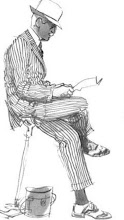
David Bagwell lives in Point Clear, Alabama, and has his own "White Shoe Law Firm" in Fairhope. In almost six decades he has never lived outside the South, although he once spent most of a year traveling around the world on a Fellowship to study international business.
Thursday, August 12, 2010
Jubilee

We had a “Jubilee” this morning at Point Clear on the Eastern Shore of Mobile Bay, Alabama.
Point Clear has been a summer resort since about 1826, when Mobilians came by steamboat to avoid the stagnant heat of the city, and at least since then “Jubilees” have been locally famous. It’s a unique natural phenomenon in which very early on rare mostly-August mornings, for a very short time, lots of flounder and crabs and shrimp and stingrays and mullet and other fish swim right up to the very edge of the beach, where a wading fisherman can net or gig a limit of fish and just about all she can use of the rest of the creatures.
Mobile Bay is a brackish [mixed salt and fresh water] estuary, and marine Scientists think the “Jubilee” results from lower-oxygen salt water coming in with the rising tide into more highly-oxidized fresher water, and the salty water pushes before it the bottom-dwelling species until they get right up on the beach and have nowhere else to go, and lie there in lethargy. Not just everybody knows that the Gulf of Mexico has only one daily high and one low tide, for unusual hydrologic reasons; whether this contributes to the phenomenon is hard to say.
Old-timers know “the signs”, and “the signs” are the things which keep the water calm and not oxygenated: an East wind off the shore; an evening rain leaving the water calm; and hot weather. Some people get out of bed several times during a likely night, to check for one; some people might even stay out most of the night to check regularly.
In the old days, very early in the morning or late at night the cry would go out: “Jubilee!”, and in times before air conditioning, most everybody would hear it and wake up and go out. Sometimes people would ring a bell. Nowadays, it is more common to make a few discreet calls on a cell phone to friends who really want to come. Not just everybody wants to get out of bed at 4:00 AM just to get a bunch of fish and crabs that have to be cleaned before work or play.
The traditional equipment includes a “flounder gig” or just “gig”, which is a spear with one single [usually un-barbed] steel spike; the frog-gigging type would work, but would make thrice as many holes, with three barbs to boot. Also necessary is “a floundering light” [a gaslight with twin mantles and a shiny concave back reflector, to see into the water], a “crab net” on a pole, and some container in which to put the treasures: a washtub or a canoe or a kayak or a plastic bucket or a long fish stringer, pulled behind like a surf caster does it, at least where the sharks won’t get him.
This phenomenon might be unique to “the Eastern Shore” of Mobile Bay, Alabama, on the Gulf Coast [attention Marylanders: other bays than the Chesapeake also have “the Eastern Shore”; fact is, a chunk of crabs sold in and from Maryland actually come from “the Eastern Shore” of Mobile Bay]. We sometimes hear that a “Jubilee” happens someplace in Burma, where the dawn also comes up like thunder oe’er the bay, but evidence of that is at best third- hand hearsay, which puts it even below the dreaded level “ancedotal” which, say the scientists, is mostly worthless as evidence, even though “anecdotal” evidence is fully admissible in Court and is used everyday by everybody to make important personal decisions.
Until maybe 2008 there wasn’t even a limit on the Jubilee flounder, but now a Jubilee fisherman with a gig must have a saltwater fishing license and must obey the limit: twelve, and the size minimum: twelve inches.
Why do it? Well, it’s a lot of fun, and it’s communal. And there is nothing like ending up with several gallon-sized plastic zipper bags full of shrimp, crab bodies and claws, and flounder filets or bodies. Boiling the crabs and cleaning the fish is not so bad, and there is still a legend of the local chef who would clean his friend’s flounders just to end up with the carcasses for fish stock for his restaurant.
“Jubilee!” It’s one wonderful thing about August, on “the Eastern Shore”. Of Mobile Bay, Alabama.
David A. Bagwell
LAT/LON: N 30 ̊31'21", W 87 ̊54'10"
web site: www.bagwellesq.com
On a personal note, Happy 10th. Anniversary to #1 Son and his bride Amy.
Toad
Monday, May 31, 2010
A History Lesson
Very few Russians show up here, but we are long on Scots. Native Alabaman's are few on the ground, and rarely pop in. For your consideration, I present Mr. Bagwell.
There was no Alabama state flag from the founding of Alabama in 1819 until 1861, when Alabama seceded from the Union, and on January 11, 1861 the Secession Convention adopted as a state flag(1)one designed by some Montgomery women.
We didn’t have a state flag again until 1895, when a statute(2)adopted the present Alabama state flag, the design of which is set out by statute, and the statute says simply “The flag of the state of Alabama shall be a crimson cross of St. Andrew on a field of white. The bars forming the cross shall be not less than six inches broad, and must extend diagonally across the flag from side to side.” The statute does not say anything about the Confederate battle flag, but in public grade school in the early 1950s I was taught that the state flag is “reminiscent of the Confederate flag”.
The Confederate Battle Flag contains the cross of St. Andrew. It is not easy to find out just why the Confederate Battle Flag contains the Cross of St. Andrew; if you type into your web browser anything containing the words “Confederate Battle Flag” you don’t get much useful information; just a whole lot of electronic hissing which is either politically- correct, or politically-incorrect, depending upon your point of view.
Why did the Confederate Battle Flag contain the cross of St. Andrew? I don’t know for sure, but I have a theory. Most Southerners [or, “Southrons” as they were wont to call themselves before The Late Unpleasantness] were Scots [or “Ulster Scots” or Scotch-Irish, who were lowland Scots who first went to Ulster in Northern Ireland to work on flax plantations or linen mills, and then left when the Church of England began to require tithes of everybody and the land rent went up quickly and significantly, “the rack rent”]. And, one scholar(3)has a remarkably catchy theory that the only way to understand the difference between Southerners and Northerners is to understand that Southerners are Celts [Irish and Scotch] and Northerners are Englishmen.
Makes sense to me, when you read it. Undoubtedly the legends of the Scots were a major theme in antebellum Southern history. So, the legend is that in putting the cross of St. Andrew in the Confederate battle flag, the Southrons were honoring and invoking their ancestors, the wild and tough Scots.
So, that still does not answer why the flag of Scotland(4)has the Cross of St. Andrew -- a sky-blue or bright- azure background with a white cross in it, the cross of St. Andrew, sometimes called “the saltire (5)cross”. Oh, you know the story; the flag of England had the cross of St. George– vertical and horizontal members– while the flag of Scotland had the cross of St. Andrew, the saltire cross– and they put them both together upon the Union of England and Scotland(6), and naval vessels flew “The Union jack ”(7), with both crosses superimposed, and later, upon union with Ireland, they added a white saltire cross, supposedly to represent Ireland. But, you knew that.
OK, so what gives with the cross of St. Andrew in the national flag of Scotland?
And, why(8)is the Cross of St. Andrew – a blue cross on a white background--the flag of the Russian Navy, the flag which they call the “Andreyevski flag”, from the time of Peter the Great to the Revolution in 1917, and from the dissolution of the USSR in 1992 until now? Why do Alabama, Russia, and the Confederate States of America use the same symbol in their flags, now?
The cross of St. Andrew is, naturally enough, named for St. Andrew, who was the brother of St. Peter and was fishing with Peter when they both became disciples of Jesus and “Fishers of Men”. According to tradition, after Pentecost Andrew became a missionary to Asia Minor, Macedonia and southern Russia, and in 70 A.D. [or, “C.E.” as the secularists would have us say, for “common era”] was martyred in Patras, Greece. He is to this day patron Saint of Greece, Russia and the Ukraine.
St. Andrew was in Patras(9), Greece, during Nero’s time, when he fatally offended the Roman Proconsul Aegaetes in Patras by (1) curing the Proconsul’s wife Maximilla, and –maybe more importantly– (2) convincing her to adopt a lifestyle of sexual abstinence [St. Andrew was supposed to have been big on sexual abstinence], and (3) making the Proconsul’s brother the first Bishop of Patras. The Proconsul, highly incensed by some or all of this, sentenced St. Andrew to die, and supposedly Andrew was crucified by being placed on an X-shaped cross, which the Romans apparently called “crux decusseta”, which means – tah-DAH! -- “cross shaped like an ‘X’”. Latter-day Confederate patriots get all upset when you say that the Confederate flag had an “X-shaped cross on it”, and they say haughtily that “it is the cross of St. Andrew!”, but heck, what the Romans called the cross upon which they crucified St. Andrew was “the X-shaped cross”; I mean, come on, now. The Romans knew their crosses, and stuff.
St. Andrew was buried in Patras with full honors, and his grave became a shrine.
OK, so, why then is the cross of St. Andrew in the Scots flag? Well, because St. Andrew is the patron Saint of Scotland.
Howcome is that? Well, this all has to do with relics and visions and stuff.
One theory(10)is the Holy Relic theory. St. Andrew’s bones were interred in Patras, and three centuries later Constantine the Great, Emperor of Rome and the guy who presided over the Council of Nicea(11) in what we now call Turkey, just across from Constantinople, and especially his mother St. Helena [whose husband had been Emperor, too, but he abandoned her for a politically-powerful woman] developed a great interest in Christian holy relics. Now, this was a time only about 300 years or so after Jesus, and it wasn’t all that hard that early to find holy relics. St. Helena hired some men who found three old crosses in the ground at the foot of Golgotha, where Jesus was crucified [promptly declared “The True Cross” of legend] and she and Constantine also had the bones of St. Mark brought to Constantinople [later to be stolen during the Crusades from the Turks and hidden in a barrel of “unclean” pig lard which the Moslem Turks would not touch, and taken to St. Mark’s in Venice] and she and Constantine set their eyes on the bones of St. Andrew, up in Patras, Greece, in order to move them to Constantinople, his capital of the Eastern Roman Empire.
The Scots theory is that some guy named St. Rule or St. Regulus [who was either an Irish assistant of St. Columba or a Greek monk, depending upon whom you believe] was directed by an Angel to take the bones of St. Andrew “to the ends of the earth” for safekeeping. St. Rule took a tooth, an arm bone, a kneecap and some finger bones from St. Andrew’s tomb [the rest were taken to Amalfi, Italy by the French later(12) ] and took them to the “ends of the earth”, which was Scotland, naturally. St. Rule was shipwrecked on Scotland and came ashore at a Pictish [the Picts were an early Scots tribe] settlement which is now called, naturally, “St. Andrews” in Scotland, the home of golf, and of the place where Queen Elizabeth’s grandson Prince Harry went to college. Maybe St. Andrew is also the Patron Saint of golf, except for the abstinence thing.
Whatever the story on how they got to Scotland, the relics of St. Andrew were in the chapel which was specially constructed for that purpose by the Pictish king Angus or Ungus– Angus mac Fergus-- who reigned from 831-861. This chapel was replaced by the Cathedral of St. Andrews in 1160, and St. Andrews [at some point they dropped the apostrophe from the apostle] became the religious capital of Scotland, and a great center for medieval pilgrims. Nobody knows exactly what happened to the relics, but during the Scottish reformation [you know; Presbyterians and simplicity and all that] likely they were destroyed or something. The place where they were kept in the cathedral is now marked by a plaque in the ruins.
But, back to King Angus, The High King of Alba, Angus mac Fergus. Aided by Scots, Angus went on a punitive raid South across the border into Northumbria, but they were pursued and confronted by a larger force of Angles and Saxons under the first Anglo-Saxon King of England, Athelstan, after whom “The Athelstan Club” in Mobile is named [the lobby of the Athelstan Club has a bronze bust said to be of King Athelstan, bolted down (thieves take note), which looks amazingly like a Roman centurion, bronze busts of Athelstan being undoubtedly rare in the market].
Defeat for Angus at the hand of Athelstan seemed certain, but he and his men prayed for deliverance, and there appeared in the blue sky a vision of the white saltire cross, the cross of St. Andrew. Angus vowed that if the Scots and Picts were victorious that day over the Angles and Saxons under Athelstan, then St. Andrew would evermore be their patron saint.
There, at what is now called “Athelstaneford”, in what is said to have been 832 AD, Angus defeated Athelstane. At that spot the saltire cross flag flies always, even at night when it is lit. The battle is commemorated on November 30th, “St. Andrews Day”.
[1] It is now known as the “Republic of Alabama Flag”. On one side was the Goddess of Liberty holding in her right hand an unsheathed sword, in the left a small flag with one star, and in the arch above her, he words “independent now and Forever”. On the other side of the flag was a cotton plant with a coiled rattlesnake, and under the cotton plant are the Latin words “Noli Me Tangere”, meaning “Touch Me Not”. This flag was flown for one month, and on February 10, 1861 it was damaged by severe weather and was removed to the Governor’s office and never flown again.
[2] Act 383, February 16, 1895, now ALA. CODE Section 1-2-5.
[3] Grady McWhinney, Cracker Culture: Celtic Ways in the Old South.
[4] Some people think that the flag of Scotland is the “Lyon Rampant”, the yellow flag with red lion rampant on it, but according to an Act of the Scottish Parliament in 1672, this is the flag reserved to the Scottish Royal family, and only they are supposed to fly it, or one of a very few “Great Officers” who officially represent Scotland, and its use otherwise is an offense. I am not part of the Scottish royal family. Are you? Any Scot, however, may fly the blue flag with the saltire cross, the National Flag of Scotland.
[5] “Saltire” apparently comes from old French, possibly meaning “stirrup-shaped”.
[6] This happened when James VI of Scotland also became James I of England, at the Union of the Crowns when Queen Elizabeth I died in 1603. King James gave us “The Union Jack” and, some say, the term “Jack” is itself named for him, but see the next note.
[7] A “jack” is a small flag a naval vessel flies on the bowstaff, indicating its nationality; in the U.S. Navy it is flown while in port from 8:00 AM to sunset. By tradition of the Royal Navy, the U.S. Navy and the Confederate Navy, the jack is the “union” of the ensign [read: the box of stars], but after 9-11 the U.S. Navy replaced the box-of-stars jack with the snake and the “Don’t Tread on Me” legend, signifying the fight against terrorists, a move which rankles some traditionalists. The “ensign” is the national flag which is flown at the stern, and the commission pennant flies at the masthead, and is normally a long and narrow flag indicating that the ship is a commissioned Naval vessel, or at least a government ship. Supposedly the whip-like pennant derives from the British tradition of hoisting a whip to the top of the mast to signify victory, in turn done in response to the Dutch tradition of hoisting a broom to signify “a clean sweep of the sea”.
[8] The website of the Russian navy, in its English portion, explains that St. Andrew had an extensive mission in Russia during his lifetime, mostly around the Black sea, and that St. Andrew is the patron Saint of Russia.
[9] Patras is a town on the northern shore of the Peloponessian peninsula, the southern shore of the Gulf of Patras, which is an inlet of the Ionian sea.
[10] A rival theory is that Acca, the Bishop of Hexham, a collector of relics, brought the relics to St. Andrew in 733.
[11] Oh, you know; in church every Sunday lots of Christian churches recite the “Nicene Creed” that Constantine’s fellow counselors at Nicea adopted as the fundamental statement of the Christian faith, back then, and has remained unchanged since then, except for the addition by the Roman Catholics [to the eternal horror of the Orthodox] of the so-called “filioque clause”, which says “who proceeds from the father and from the son”, suggesting to the Orthodox that perhaps Jesus was somehow his own father, not unlike the country music standard “I’m My Own Grampaw”. This stuff makes a huge difference to a lot of people.[12] The larger part of the relics were taken from Constantinople in 1210 and are now found in Amalfi in Southern Italy. In 1879 the Archbishop of Amalfi sent a small piece of the Saint’s shoulder blade to the re-established Roman Catholic community in Scotland, and during his 1969 visit, Pope Paul VI gave further relics of St. Andrew to Scotland with the words “St. Peter gives you his brother”, and these are now displayed in a reliquary in St. Mary’s Roman Catholic Cathedral in Edinburgh.
David Bagwell lives in Point Clear, Alabama, and has his own "White Shoe Law Firm" in Fairhope. In almost six decades he has never lived outside the South, although he once spent most of a year traveling around the world on a Fellowship to study international business, during which he almost always wore a suit, but never a white suit or white shoes, since the message of a white suit in -say-Rangoon or Calcutta, or ever Marseilles, might convey a different messsage than intended.