Tuesday, July 31, 2012

Party at our house

You may remember meeting my buddy Joe "the chick magnet" at a wedding some months ago. He's now a toddling 14 month old and in spite of the devil in those eyes, he is the sweetest little guy you'll ever meet.

He has to be since he is the little brother. A kid learns to go along, to get along. Joe, before he learned to utter a word, knew how to charm the birds out of the trees. His smile cures most of his problems. Works wonders.

Joe's brother on the other hand...a 3 1/2 year old scamp... the Christmas goose has nothing on him. Whirling dervishes don't have the energy to keep up with this 3 year old all day. Their ears would wear out first.

Early yesterday, big bro called Mrs. T and told her, "I go to your house. We have a party" Mrs. T likes parties and refuses him nothing, so quick as a wink the boys appeared.

A marvelous party it was too. We played games, watched Sesame Street, searched for the dogs and had party treats. Who says you can't give a kid mouse cake at 9:30 AM, so long as you send them home quickly?

It's a thrill a minute around here, you're invited too. Just don't call so early.

Toad

Monday, July 30, 2012

Hints Heloise would never share

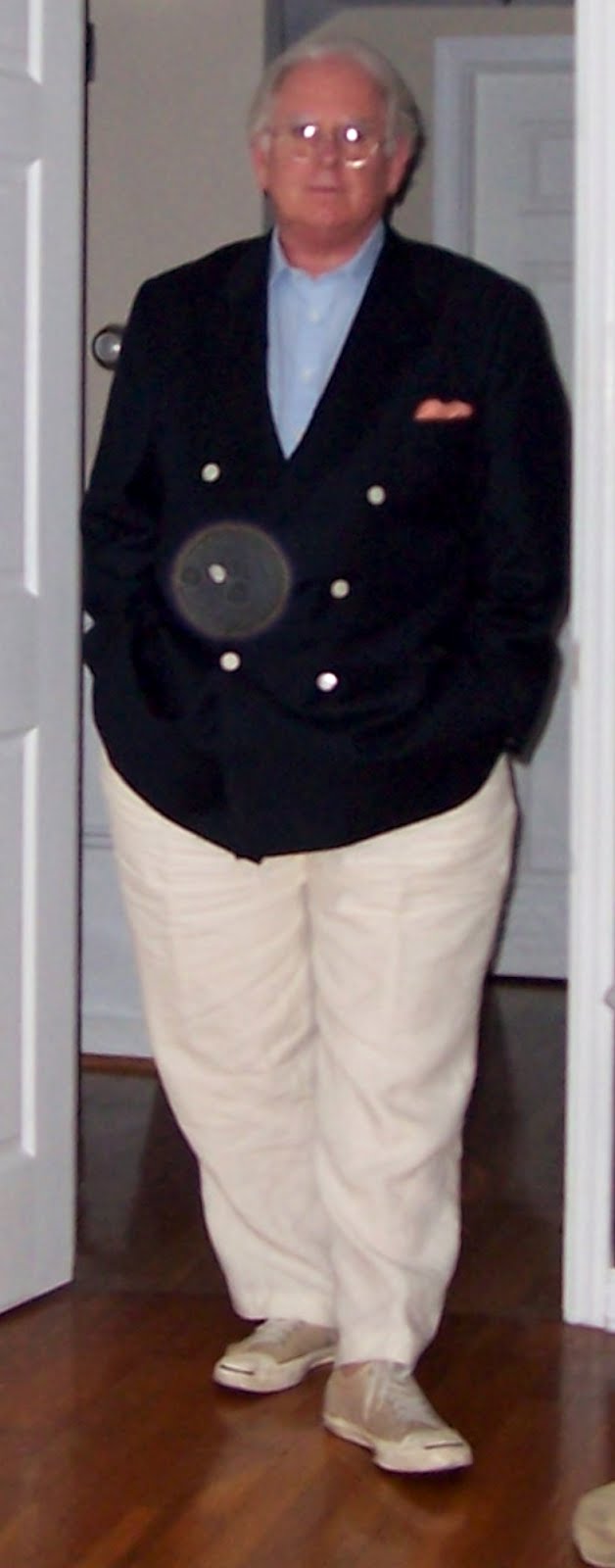
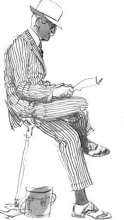
One may copy Ralph's look, but never his style. My get up for date night Friday. My footsies were comfy though but when temps are over 100F (42C) I'll give the tie a miss on a casual night.


Are you plagued by pets? I sometimes feel that I am, especially when they take advantage of our good nature or when we go out. I'm often not paying attention when we return so it may be a surprise to find that one or the other (most likely the 15 yo deaf and half blind guy) has slunk off to water an area rug in a infrequently visited room.

Any number of carpet cleaners promise to remove stains and odors, and most work well on fresh deposits but cleaning up dry messes is a chore. I've found a solution, that may work for you. I've only done this once, on a colorfast rug, and
do not recommend it on natural dyes, unless you have a thing for bleeding madras.

Take the rug outside and prop it over something so it's not directly laying on the ground. Then turn the hose on it. Soak it good. Do it again, then again. In an hour or so do it once more, this time hosing off the ground underneath. You'll understand why once you're there. For sport, in another hour you may want to soak off the rug again, just for good measure, and leave it in the sun to dry. In a day or so it will be dry, fresh and clean smelling.

The photo above was taken Sunday afternoon. Saturday night Mrs. T suggested I bring it in, I countered with "give it one more night". We awoke to rain Sunday morning. Another lesson learned.


The waterfall fountain works, and makes the most soothing sounds. The neighborhood frogs have found it and appear most happy playing in the cement pond. Hopefully they will come to prefer it over the pool and its chemicals.

Toad

Friday, July 27, 2012

Why reinvent the wheel?

Photo from Ralph Lipschitz

I believe I'll toss most of summer wardrobe away and wear what Mr. Lauren wears. The Jacks make it Perfect.

Toad

Thursday, July 26, 2012

Hot fun in the summertime

The sage of New England, Yankee-Whisky-Papa author of Boxing the Compass stopped in Mayberry for a brief visit, on his way home after counselling those in need of his particular brand of expertness. I invited him to dinner.

It was 107F (42C) at 7PM when I picked him up, YWP had driven 150 miles from his 7 hour professional dance and comes in perfectly pressed suit, tie snug around his neck, with hardly a care in the world. I, who had been working outside much of the day, undecided between wearing something cool and comfortable, or dressing like an adult, split the difference and arrived looking like an unmade bed, in guaranteed to wrinkle, quickly, linen. I'd hate him for such elan, but he's wonderful company, and I had a great night. Should you have the opportunity invite him over. He's likely to show.

I've spent my time during this week's heat wave repairing our fountain. Outside our door is a waterfall of sorts with what could be a small wading pool at the base. When we moved here the pond was full of water, and made the most wonderfully soothing sounds as water cascaded from one level to the next. We assumed it always worked that way. Wrong. The base no more holds water than your kitchen sieve. Every year since, I've sworn that this will be the year it comes back to life. This WILL be the year.

Concrete work is completed, border stones are mortared, tomorrow is DRI-LOCK waterproof painting day. First coat white, the second tinted blue.


Now if it leaks, it will be covered over with dirt and debris Saturday, never to be spoken of again.

Once upon a time the previous owners had the house re-shingled. For reasons known only to the gods, the roofing pro's removed the old flashing (the piece which joins a lower level roof to the side of the house) replacing the join with roofing tar. It doesn't work for long and that seam has leaked ever since.


Being miserably hot, I felt it may be time to retroactively install the flashing. The young man shown above melted his noggin on our south facing garage roof, working most of the afternoon. He worked hard, did an excellent job, cleaned up and FOLLOWED UP.

He'd be a great catch for some lucky girl.


Toad

Monday, July 23, 2012

Mayberry's marathon from hell


In anticipation of the upcoming London Olympics, I've spent time snooping the archives for tales of the Mayberry Olympics, Olympiad III held in the summer of 1904. In honor of the centennial of the Louisiana Purchase , Mayberry's town fathers decided to hold a World's Fair. Out of towners visiting Mayberry ever since, may be forgiven for believing the Fair was a recent event, since the Fair creeps into most local's conversations with travelers, and as local events are still dated BF (before Fair) or AF (after Fair) by that element. Anything much past the Fair is held in very low regard in these parts.

Fair organizers, as long as they were going to all the trouble to hold a Fair, decided they may as well host the Olympics as well. Poorly organized and clearly a ugly cousin to the Fair, the Mayberry Olympiad nearly killed off the nacscent modern Olympic movement. The story of the Marathon may give you some indication how most things Olympic went. The story below may be unintentionally, the funniest true sports story you will ever read.

The start of the Marathon


The Marathon From Hell
by Eileen P. Duggan

The 1904 St. Louis Olympics Were Scabbed onto the World's Fair, a Recipe for Disaster That Only the Hot August Marathon Could Top.

Modern-day marathon runners are fond of recounting their tribulations on Boston’s Heartbreak Hill. But imagine the hardships endured by the runners in the 1904 Olympic Marathon as they navigated hilly, unpaved roads while choking on dust and exhaust fumes and fighting oppressive heat. Even those who availed themselves of a little spiritual, medicinal, or physical help from their friends along the way found the course unforgiving.

One hundred years ago, the first modern-era Olympic Games to be held in the Western Hemisphere came to St. Louis, Missouri, a bustling river city that was in the midst of a world’s fair to celebrate the 100th anniversary of the Louisiana Purchase.

The marathon, which kicked off at Washington University in St. Louis, was certainly the most colorful event of the III Olympiad. The Games received mixed reviews and were overshadowed on the world stage by the 1904 World’s Fair. The Olympics were included under the umbrella of the fair’s Department of Physical Culture.

“At no time during the race was the Greek record for the distance in danger,” understated Charles J. P. Lucas, in his book, The Olympic Games 1904. No record breaker, the marathon at least deserves points for its grueling conditions, unique cast of characters, and bizarre occurrences.

The First Challenge
The first hurdle the marathoners and their fellow Olympians faced was getting there.

In 1904, Charles Lindbergh had yet to make his epic transatlantic flight and the Wright brothers were still perfecting their glider, so a visit to St. Louis from Europe, Africa, or Asia meant a long, expensive ocean voyage and a 1,000-mile train trip. Only 11 other countries sent athletes to the Games, so Americans were in the majority. Even the International Olympic Committee founder, Pierre de Coubertin, opted to stay home in Paris. U.S. President Theodore Roosevelt didn’t attend either, although he agreed to be honorary president of the Games in concert with the president of the Louisiana Purchase Exposition, former Missouri Governor David R. Francis. Also a former mayor of St. Louis, Francis had wrestled the fair away from first-choice Chicago to tie it into the Louisiana Purchase centennial.

At that time, the Olympics, which had been revived in 1896 in Greece, were not yet considered a competition among countries but of amateur athletes competing against each other. Many of these athletes were sponsored by athletic clubs or colleges, but often the Olympic hopefuls had to pay their own way to the Games. The complications of arranging and financing such a long trip no doubt kept many good athletes away from the St. Louis Games.

One who didn’t stay away was Cuban runner Felix Carvajal. Although he was able to skip the long ocean voyage, he lacked the finances to travel inland to St. Louis. The postman from Havana had little experience in track events, but he knew about endurance. He entered the marathon race to honor his homeland, even though his country had failed to invite him to join the Cuban national team. Without a sponsor, Carvajal raised travel money by using his greatest assets: his feet and his gregarious personality. He collected enough cash for a freighter ride to New Orleans by giving running demonstrations around the Havana town square and begging for money from the onlookers.

In New Orleans, a dice game soon separated Carvajal from his remaining money. So he made the rest of the trip by hopping boxcars and hitchhiking. When he finally arrived exhausted and hungry in St. Louis, he endeared himself to the weight throwers on the American team, who shared their food and lodging with him. He didn’t pay much attention to their training tips and pacing strategies. Carvajal showed up at the starting line wearing a long-sleeve white shirt; heavy-heeled street shoes; and long, dark pants. Just before the race, one of the U.S. discus throwers, New York police officer Martin Sheridan, sheared off Carvajal’s pants at the knee.

The Contestants

Approximately 680 athletes, about 525 of them Americans, participated in 94 events, according to figures published by the International Olympic Committee. Precise figures on participants and events vary among sources because of the loss of some official records in a fire at the office of the Amateur Athletic Union of the United States, which organized the events. In addition, the IOC never published its customary official report. Further complicating the record keeping was the decision by fair officials to label any athletic competitions during the fair as “Olympic” contests. The official Games were held August 29 through September 3, 1904, although numerous so-called Olympic events were held from May through November as part of the fair. The IOC decided only after the fact which events were deemed official, according to Olympic historian Bill Mallon, whose book The 1904 Olympic Games attempts to reconstruct the results for all competitors in all events.

Dominated by Americans, the marathon entrant roster’s only non-Americans were the Cuban, two Kaffirs from South Africa, and 10 runners representing Greece. Most of the Greeks, however, had been living in the United States for several years. Only 32 of the 36 entrants—men only, in those days—actually ran the race.

The Course

David Francis also called on his status as a prominent 1870 graduate of Washington University to get the fair and Olympic Games located in Forest Park and on nearby property purchased by his alma mater for a new campus on the outskirts of the city. The now-historic Francis Field and Gymnasium, as well as a 12,000-seat stadium, were built on the soon-to-be university campus for the Olympic track and field events. Francis Field served as the start and finish lines of the marathon.

The 24.85-mile marathon was set to begin at 2:30 p.m., August 30, a major scheduling folly considering that in St. Louis summers, heat and humidity go together like a horse and carriage. The temperature was in the 90s and the humidity about the same, producing a heat index higher than a record-breaking high jump. Only 14 of the 32 starters completed the dusty, hilly, and mostly unpaved course, complete with seven steep hills. If the heat didn’t fell the runners, exhaust fumes and dust from the many pacer automobiles did. Some of the participants were seasoned marathoners who had already won or placed in the Boston Marathon and other major races, but they were no match for the hellish St. Louis course.

“The course through St. Louis County was the most difficult a human being was ever asked to run over,” wrote Lucas, who happened to be a trainer of the eventual winner. “The roads . . . were frightful.”

A team of horses that preceded the runners to clear the course literally left the marathoners in the dust. To make it worse, runners had to dodge bicycles and chase cars of handlers, officials, and reporters as they bumped along the roads spewing exhaust fumes and kicking up yet more dust. The freshly invented automobile was all the rage, but emissions regulations were not yet a twinkle in some bureaucrat’s eye. Drivers’ training also left a lot to be desired. At one point, two officials swerved their car to avoid a runner and ended up in a ditch with serious bodily injuries.

“Had it not been for the automobiles, the race would have been run under three hours,” Lucas wrote.

Another obstacle on the course was the presence of cracked stone strewn over some of the roadways. “Runners were compelled to pick their way through this wretched footing as best they could,” Lucas wrote.

Only one water stop was available, at a well located about 12 miles from the stadium, although trainers did provide their runners with water and other libations along the way.

The Winners

After the three-hour mark, the crowd in the stadium—some 10,000 people turned out to watch the race—began to weary of waiting for the runners to return.

Finally, three hours and 13 minutes after the start, the apparent winner, Fred Lorz, sponsored by the Mohawk Athletic Club of New York, entered the stadium, barely breaking a sweat. As he was about to be adorned with a floral wreath by first daughter Alice Roosevelt, Lorz confessed that he had ridden about a third of the way in an automobile.

It seems that Lorz, who was an early leader in the race, was felled by the heat and cramps at about the halfway mark. He stopped to rest, waving at the other runners as they passed. Realizing he was out of the race, Lorz accepted a ride from one of many cars along the course. After passing all the competitors, Lorz’s ride broke down about five miles from the stadium. Feeling refreshed, Lorz got back on his feet and continued on to the finish line, where he was met by cheers. He ran into the stadium only to get his clothes but couldn’t resist the adoring crowd—at least, that was his story, and he was sticking to it.

Naturally, Lorz was disqualified despite his claims that it was all a joke, and the AAU suspended him for life. The suspension was later rescinded, based on testimony from some of his marathon competitors who had seen him waving jovially from the car and the sidelines. In 1905, Lorz went on to win the Boston Marathon, presumably sans wheels.

Meanwhile, back on the dusty course, New Yorkers Sam Mellor and Arthur Newton, also sponsored by Mohawk, struggled for the lead until Mellor, winner of the 1902 Boston Marathon, succumbed to the heat at around the 16th mile. With nine miles left, Newton, who had come in fifth in the 1900 Paris Olympic marathon, started walking and lost his lead.

Dragging in to the finish line at 3:28:53, supported by his handlers, was English-born Thomas Hicks of Cambridge, Massachusetts, who passed out before he could claim his rightful first-place prize. By today’s standards, he also would have been disqualified, as his handlers kept him moving along the way by administering a mixture of 1/60-grain strychnine sulfate (rat poison) and raw eggs with a brandy chaser. But it was all perfectly legal then.

“The Marathon race, from a medical standpoint, demonstrated that drugs are of much benefit to athletes along the road, and that warm sponging is much better than cold sponging for an athlete in action,” Lucas boasted. “Hicks was far from being the best man physically in the race, for there were three men who should have defeated him . . . but they lacked proper care on the road.”

Hicks had started fading about 10 miles from the finish line. He asked for water but instead had his mouth sponged out with distilled water by handlers Lucas and Hugh C. McGrath. Seven miles from the stadium, they administered the first dose of medicinal help. With four miles to go, Hicks begged to lie down, but Lucas and McGrath wouldn’t allow it, encouraging him to slow to a walk instead. When his color turned ashen, they gave him another dose of “proper care” as well as a sponging with water from the boiler of a steam automobile. When he crested one of the last hills two miles from the end and saw the crowds cheering him on, Hicks began trotting again, albeit like a zombie. After yet another boost of eggs and brandy, he plodded down the home stretch, babbling deliriously about food. After crossing the finish line in a daze, he was carried to a dressing room where doctors worked to revive him long enough to collect his Francis Cup and gold medal. Then, a sleeping Hicks finally rode a streetcar back to his bed at the Missouri Athletic Club.

“I am sorry to say that the road is the hardest over which I ever ran,” said Hicks, as quoted in the St. Louis Republic the next day. “I have done the distance in little over two hours and a half, but today I did my best. I lost 10 pounds as it was, and you can see that I could not push myself any faster and lose more.” Hicks hung up his running shoes after that marathon.

Frenchman Albert Corey, who had made a poor showing in Paris, managed to take second place, finishing in 3:34:52, six minutes after Hicks’s tortured arrival. A strikebreaker by trade, Corey had come to Chicago in 1903 to bust a butcher’s strike, then stayed in Chicago to work and train for his comeback, this time representing the USA.

Newton finally caught up and finished third at 3:47:33.

Coming in fourth was none other than Felix Carvajal, who had become something of a folk hero. “He won the sympathy of the crowd in the stadium and raised his hat each time he passed the stand,” the St. Louis Republic reported.

Despite having no handlers, no strategy, and no training program, Carvajal seemed to sail in unfatigued. Legend has it that the lightweight, diminutive Cuban ran a casual race, stopping to practice his English with spectators and even running backward occasionally as he chatted. He might even have won the race but for a hunger attack. At one point, he detoured from the course into an apple orchard for a snack. Alas, the green apples—or maybe the peaches he snagged from Hicks’s handler, Lucas—triggered stomach cramps, causing Carvajal to stop and rest. He eventually recovered enough to start running again and finished the race behind Newton.

The Also-Rans

Among those felled by the rough conditions were John C. Lordon of Cambridgeport, Massachusetts, and San Franciscan William R. Garcia. Lordon, winner of the 1903 Boston Marathon, had to withdraw after being overcome by vomiting near the 10-mile mark. Garcia’s departure from the race was more dramatic: he was found lying unconscious on the roadside by a local couple who were following the race in their car. They took Garcia to the fair’s medical headquarters, from which he was rushed to a hospital. It turned out that the dust clouds he had inhaled had nearly destroyed his stomach lining, but he recovered within a few days.

Michael Spring, of New York, who had won the Boston Marathon earlier in 1904, led the pack as it left the track and kept a steady pace until he collapsed from exhaustion while attempting one of the steep hills.

While the killer course picked off those seasoned marathoners, two men who entered the race on a whim did reach the finish line. South African Kaffirs Len Taunyane, known as Lentaw, and Jan Mashiani, known as Yamasani, were participants in the fair’s Boer War exhibit. Having some experience as dispatch runners during the war, they decided to enter the race.

Lentaw and Yamasani were the first black Africans to participate in the Olympics. The only other minority in the race was an American Indian, Frank Pierce, sponsored by the Pastime Athletic Club of New York. A victim of exhaustion, Pierce had to be driven back to the stadium. Although he didn’t enter the marathon, American George C. Poage was the first black runner to win an Olympic medal, taking the bronze in the 200- and 400-meter hurdles.

Yamasani finished 12th, and Lentaw might have done better than his ninth-place finish if he hadn’t been chased a mile off the course by a dog.

Other finishers included fifth-place runner Dimitrios Velouis of Greece and his countrymen Christos Zekhouritis and Andrew Oikonomou and Americans David Kneeland, Henry Brawley, Sidney Hatch, F. P. Devlin, and John Furla.

Although the St. Louis Games were a smashing success for the Americans, IOC officials were not impressed by the international participation. And they had repeated their error of embedding the 1900 Paris Olympics into a larger event and got the same result—the Games became a sideshow to a world’s fair. They sought to save the Olympics by scheduling off-year contests in Athens every four years. Following a successful effort in 1906, political unrest in Greece prevented a rerun, and the plan was scrapped.

Toad

The men's gymnastics Olympic champion in 1904, American, George Eyser had a wooden leg.

Sunday, July 22, 2012

Life is Art

photo from Daily Dooley

If you have never been to Madrid by all means GO! It's one of the world's great capital cities, think of it as a laid back London, and don't worry about the language barrier, it is not a problem. Madrid is also one of the world's greatest museum cities. The art in the Prado's lobby makes it worth the trip.

As great as Madrid's art is, it can also be its downfall. Have you ever hit the vacation wall? You've experienced too much, too soon, it's days before returning home, you want to run screaming from wherever you are and be coddled by your own toys in familiar surroundings. I have...in Madrid.


Our fourth day in town, a cold rainy November Sunday afternoon, was spent in the galleries of the Museo Reina Sofia. We come to see Pablo Picasso's Guernica, and stayed for the tour. It may have been our tenth museum in as many days, and midway through I hit the wall. I told Mrs. T not to worry, I'd find her in while, and walked off to collect myself.

Hidden away on that gray day, with neither warning, guide or signage I stumbled into a hidden away gallery with 100 Alexander Calder mobiles on display, all close enough to touch, but you'd likely be shot for trying.

On the dreary afternoon, a room with vivid color, modern art, light and whimsy saved my sanity. Thank you Mr. Calder. Happy Birthday.

Toad

Friday, July 20, 2012

This just may become yours

I've had two songs rattling in my head the past several days and they appear reluctant to leave. Should enough of you watch/listen to these videos perhaps the songs will be exorcised from my head into the ether, or should we have exceptionally good Karma one or both just might transfer to your head instead. Good luck and thanks for playing along.


This clip shows Fred Astaire at his best. Other than the boots I've always wondered what Bev brought to the band. She reminds me of an old flame.

Also:


May what's mine become yours.
Toad

Thursday, July 19, 2012

As old as America

Good Bye and Keep Cold
Robert Frost

This saying good-bye on the edge of the dark
And cold to an orchard so young in the bark
Reminds me of all that can happen to harm
An orchard away at the end of the farm
All winter, cut off by a hill from the house.
I don't want it girdled by rabbit and mouse,
I don't want it dreamily nibbled for browse
By deer, and I don't want it budded by grouse.
(If certain it wouldn't be idle to call
I'd summon grouse, rabbit, and deer to the wall
And warn them away with a stick for a gun.)
I don't want it stirred by the heat of the sun.
(We made it secure against being, I hope,
By setting it out on a northerly slope.)
No orchard's the worse for the wintriest storm;
But one thing about it, it mustn't get warm.
"How often already you've had to be told,
Keep cold, young orchard. Good-bye and keep cold.
Dread fifty above more than fifty below."
I have to be gone for a season or so.
My business awhile is with different trees,
Less carefully nourished, less fruitful than these,
And such as is done to their wood with an axe--
Maples and birches and tamaracks.
I wish I could promise to lie in the night
And think of an orchard's arboreal plight
When slowly (and nobody comes with a light)
Its heart sinks lower under the sod.
But something has to be left to God.


Unlike Frost's young orchard our old white oak sheltered fingerlings, frogs and turtles beside the lake before the American Revolution. It was a magnificent specimen, until age caught up with it.

It now goes on, towards other uses, but will be sorely missed.
Toad

Wednesday, July 18, 2012

When the going gets tough

"When the going gets tough, the weird turn pro." Hunter S. Thompson

A rite of passage for young males, post acknowledgement of the existence of girls and the first driver's license, most likely before the first nip of corn squeezin's comes one's first trip to the bookstore in search for non school assigned literature. For most, it's a dance with the forbidden, a taste of the provocative. With luck, understanding and good breeding that dance with the outlier never leaves.

Chosen wisely, your first pick may influence the rest of your life. Mine did. By the time the National Lampoon turned stale, Hunter Thompson's novel, Fear and Loathing in Las Vegas was serialized in Rolling Stone. He had me at hello, I never looked back and never regretted the ride.

In the era of Richard Nixon, Thompson's worldview and willingness to pop the ego balloons of the rich while pointing fingers at the criminals driving the bus of state and their lackey's provided incredibly solid education to the machinations of American government at its highest levels. Looking back at how politics has changed over the last 40 years Thompson appears a naif.


We didn't always agree, no one could always agree with Hunter. I do miss him though.

Happy Birthday Hunter, wherever you are.

Toad


Tuesday, July 17, 2012

How it used to work

Thursday, 17 July 1941

U.S. Army Brigader General Brehon B. Somervell, head of construction for the Department of War, ordered Lt. Col Hugh Casey and architect George Bergstrom to his office. Somervell told the 2 men he wanted them to develop plans for building to house the Department of War, to be located in or around Washington DC. The building specs were: it must be air conditioned, provide office space for approximately 40,000 personnel, be not more than 4 stories tall, nor greater than 4 million square feet, and it must be without elevators.

General Somerville then ordered the plans and an architectural perspective be on his desk not later than Monday. Casey and Bergstrom delivered. The Secretary of War approved the plans Tuesday and notified the President, while Somerville went hat in hand to Congress.

Plans were tweaked, but basically unaltered, a floor added and a site settled on during the next several weeks. Construction began September 11, 1941.

Toad


Sunday, July 15, 2012

Helo

In 1962 beautiful, seventeen year old, Heloísa Eneida Menezes Paes Pinto was seen lounging on the beach by composer Antonio Carlos Jobim. Literature and music are each rife with stories of young girls inspiring older men. Carlos, under the influence of this young woman composed a song, which when later recorded by Portugese/English translator Astrud Gilberto with her husband and Stan Getz won the Grammy Award for Song of the Year 1965.

Last week was Helo, the Girl from Ipanema's, 67th birthday. She still inspires.

Cruelly, she never earned a dime from the recording, and Jobim and company unsuccessfully turned the dogs on her when she attempted to open a clothing store near the beach in Rio under the name "Girl from Ipanema". Today, she is a model, businesswoman, occasional television personality, and has twice appeared (most recently with her daughter) as a Brazilian Playboy Playmate (the more curious can find the photos with no help from me).


My leering at similar inspiration would most likely lead to domestic abuse charges.

Toad


Saturday, July 14, 2012

Fete de la Federation

Photo by Cedric

A visual reminder of Bastille Prison remains on the streets of Paris, marked in the cobblestones of Place de le Bastille. The lighter stones show the outlines of the prison, the symbol of a despot's tyranny which was attacked on this date 1789, freeing its 7 prisoners and marking the beginning of the French Revolution.

I proudly admit to being a lifelong Francophile. While mutually wary of each other, our two countries have a long history of mutual dependence. Both the US and France are free nations due to the others intervention. The world however, owes a debt to France, for it is from the French, including her later kings that our notion of the good life, which includes fashion, fine food and wine, chic cafe society, style, sophistication and glamour descend. French style began to lead the world in the late 1600's and they have led the way since.

Happy Independence Day, friends, from a grateful nation.

Toad

Wednesday, July 11, 2012

Giorgio Armani

The Sartorialist
Giorgio was born on this date in 1934.

“I was the first to soften the image of men, and harden the image of women. I dressed men in women’s fabrics, and stole from men what women wanted and needed—the power suit.” -Giorgio Armani

Founding his menswear line in 1974, and women's in '75, Armani made the strategic decision to build his brand around celebrity clients in the hope and expectation that their fans would become his. His strategy worked beyond his wildest dreams, beginning with Richard Gere's wardrobe in American Gigolo continuing with Lady Gaga in 2012.

Happy Birthday sir.

Toad

Tuesday, July 10, 2012

Battle of Britain


The Battle of Britain began on this date 1940. God bless all who served and their families.

Toad

Monday, July 9, 2012

Molesey Boat Club

Winner of the Thames Challenge Cup 2012
Photo by Tim Jenkins

With many thanks to Goren Buckhorn of Hear the Boat Sing

Toad

Finnian


Film is
It Must be Thursday by Lou Watson


I received a bit of fan mail last week from my new BFF, Finnian. We've never met and I've only seen him on celluloid, but I've come to adore him. His mother was showing off Finn's sister's graduation photos and there he was, 11 years old, decked out in bow tie and braces, the best dressed gent in town.

A young man with such an innate sense of personal style needs encouragement so gave him my favorite madras bow from Ellie Stager, The Cordial Churchman.


Within days I received this thank you letter and drawing.


I've pasted his letter into my Moleskine notebook and will cherish it forever. Thanks to Ellie as well. She's made us both very happy.

Toad

Sunday, July 8, 2012

Curses!! Foiled again.


There are quests, and then there are Quests. I've worn fewer bow ties lately, their place taken by an array of striped silk square bottomed knit ties. What used to be called Rooster ties.


The ties above are place holders for what I've set as my ultimate goal, a navy and white or black and white stripe number as worn by the always elegant Mr. Barbera in the first photo (taken by the Sartorialist)

In my mind's eye the navy (or black) stripe would be the perfect accompaniment to most of my summer suits. Admittedly, I haven't broken into a sweat searching, but I've yet to find it among the low hanging fruit. What I did find is the photo below taken at the Henley Regatta last weekend. The photo shows members of a rowing club in matching club ties and blazers. The b**t**ds are wearing my tie.

photo by Tim Jenkins

There is just enough Hail Britannia in me to give me pause before wearing the club colours of an active club to which I do not belong. Hemingway wrote about F. Scott Fitzgerald with such a dilemma in "A Moveable Feast".

"I kept on observing Scott. He was lightly built and did not look in awfully good shape, his face being faintly puffy. His Brooks Brothers clothes fitted him well and he wore a white shirt with a button-down collar and a Guard’s tie. I thought I ought to tell him about the tie, maybe, because they did have British in Paris and one might come into the Dingo [bar] – there were two there at the time – but then I thought the hell with it and looked at him some more. It turned out later he had bought the tie in Rome." via Clothes in Books

Even though the club members will never know, and no one I'm ever in contact with will ever
know the tie's origins, I'll know. Probably won't stop me from buying it though.

Toad

Saturday, July 7, 2012

Happy Birthday Satch!

Painting by Jessica Gandolf

Many of you may be unfamiliar with Leroy "Satchel" Paige. Born on this date, probably in 1906, Satch was one of the greatest players to ever play professional baseball, . Unfortunately, most of his 22+ year career was spent in the Negro Leagues, as black athletes were banned from Major League Baseball until 1947. Satch joined the majors in 1948, pitching his last professional game in 1965 where he threw a 3 inning shutout for the Kansas City Athletics (remember the Kelly green and gold uniforms?). Mr Paige was reportedly 59 years old at the time. He entered the Baseball Hall of Fame in 1971.


His light was never hidden under a bushel as he willing shared his philosophy of life with all who would listen. A natural philosopher Mr. Paige is credited with these Rules for Right Living. Their homespun wisdom is as applicable now as ever.

Satchel Paige's Rules For Right Living

Avoid fried foods which angry up the blood.

If your stomach disputes you, lie down and pacify it with cooling thoughts.

Work like you don't need the money. Love like you've never been hurt. Dance like nobody's watching.

You win a few, you lose a few. Some get rained out, but you got to dress for all of them.

Keep the juice flowing by jangling around gently as you move.

Go very lightly on the vices, such as carrying on in society-The social ramble ain't restful.

Avoid running at all times.

Don't look back, something may be gaining on you.

Happy Birthday wherever you are, Mr. Paige.

Toad